Keeping On An Even Keel: Advice From The Daily Mirror

001

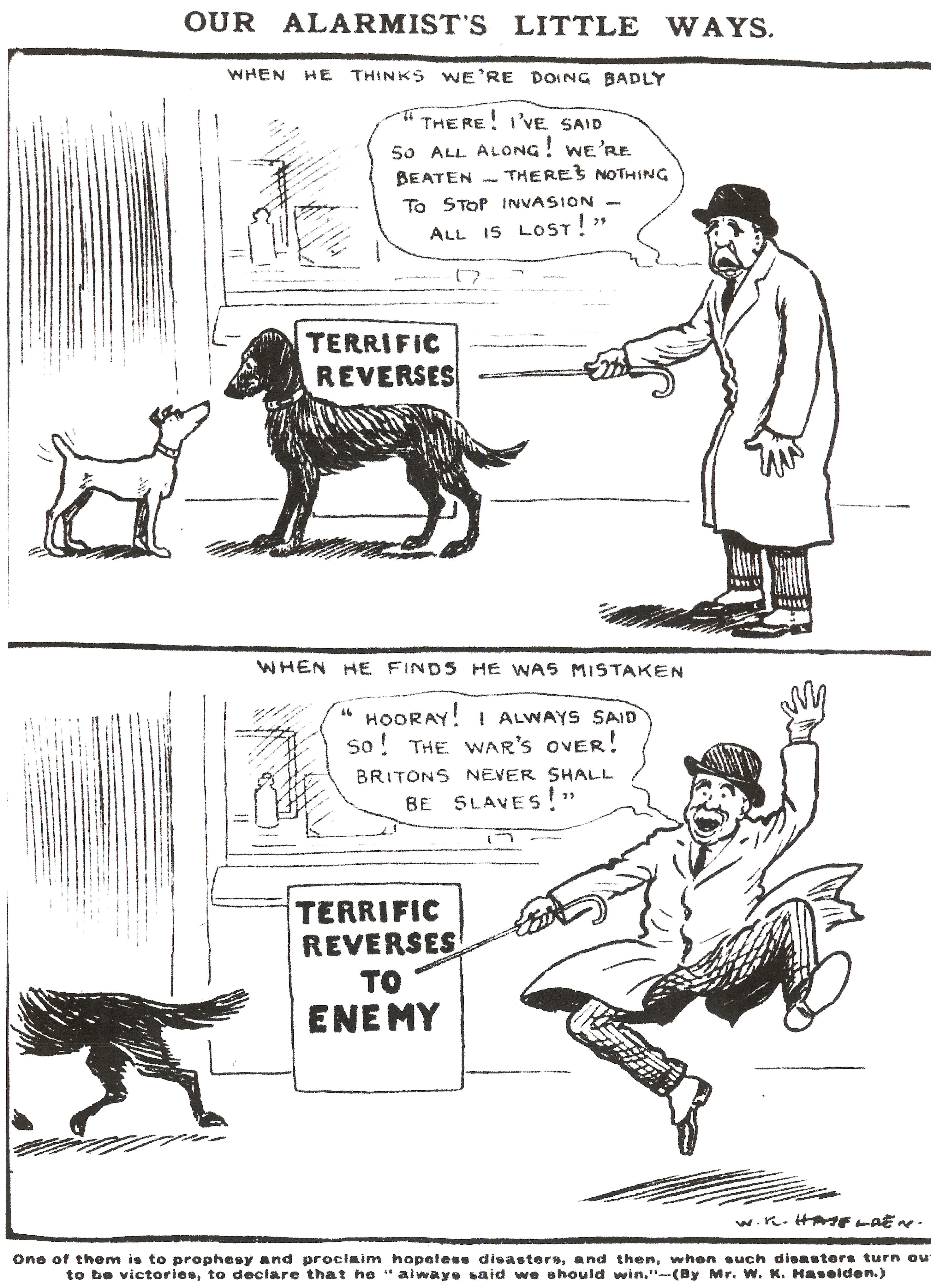
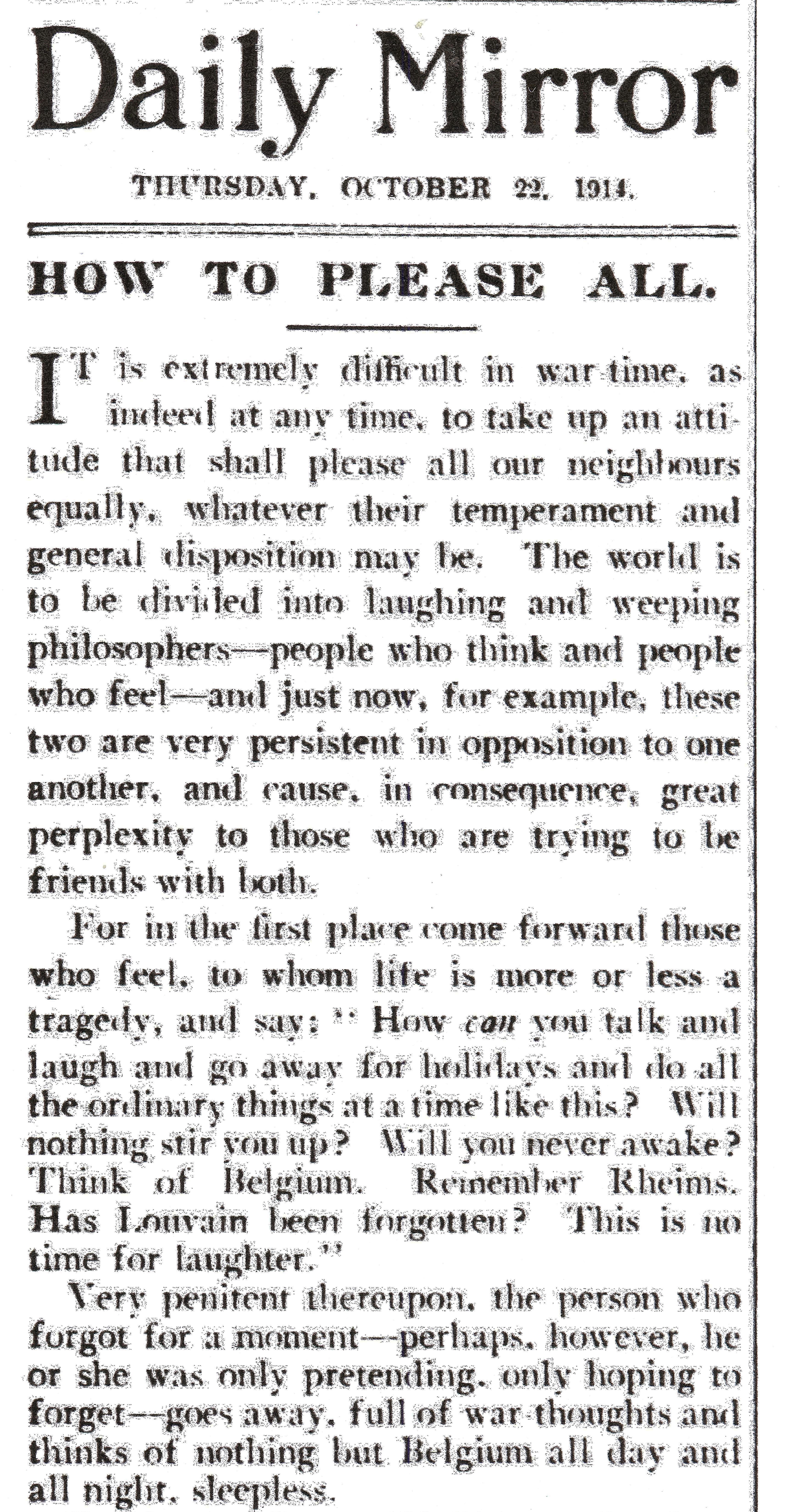
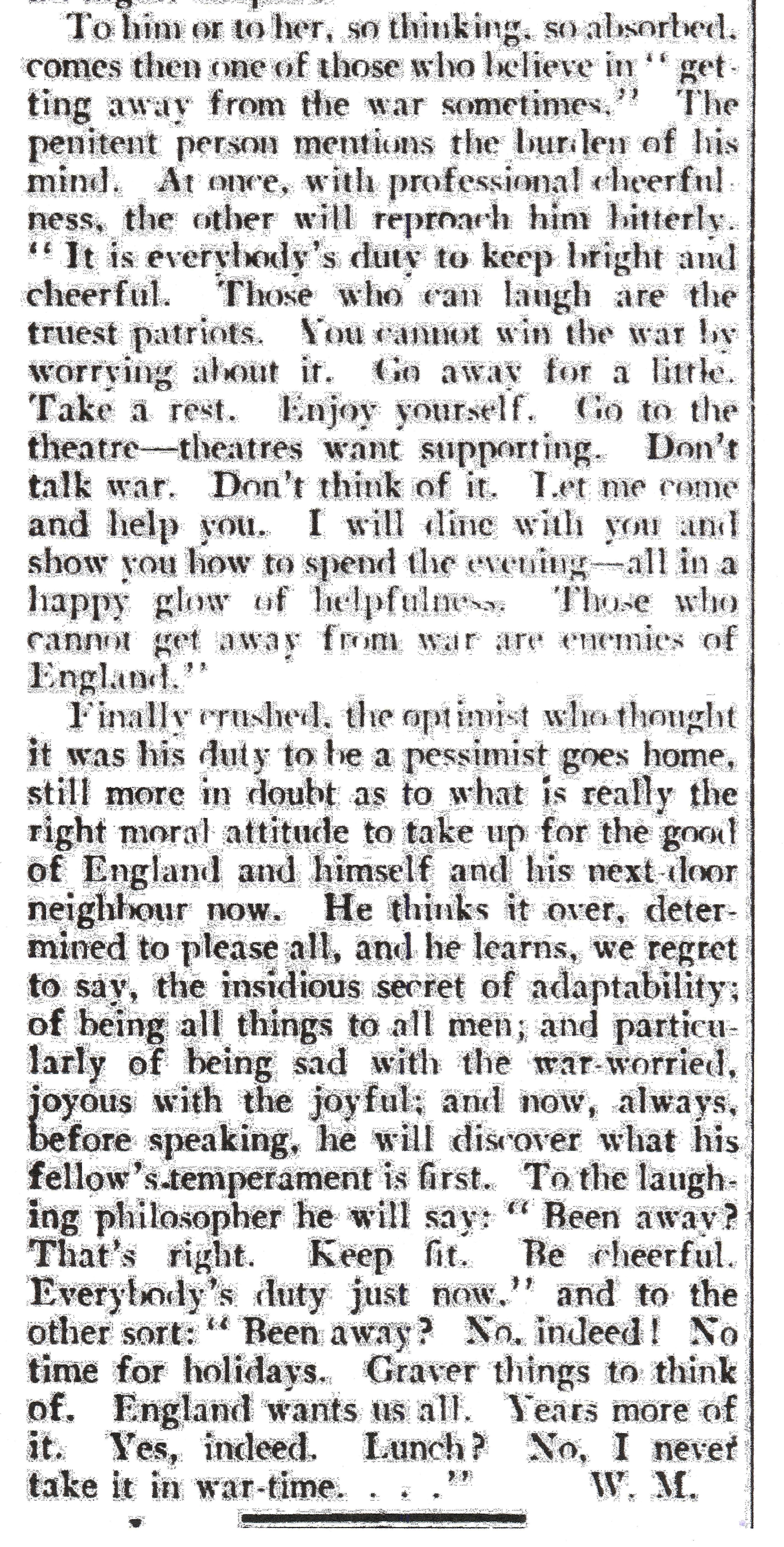
Editorial Page The Daily MIrror 22 October 1914 courtesy The British Newspaper Archive

aaa 001The Reverend William Tovani was rather taken with today’s editorial and cartoon in The Daily Mirror and wondered if he could get away with turning them into a sermon with only the most minimal editing. After all, if there could be a sermon in stones, why indeed should there not be a sermon in one’s daily newspaper?

It was rather fascinating, in a grim sort of way, the degree to which the war seemed to be having an infantilising effect on his congregation. Normally both robust and level-headed, many of them seemed to be rushing to him with every little metaphorical scratch and asking him, in effect, to ‘kiss it better’, as he promised his children. Their moods were all over the place, one minute elated and the next in the depth of despair as they reacted and over-reacted to the news from the battle front.

He was in little doubt in his own mind that the war would last for many months, if not years, and the only sensible choice, to use another metaphor – this time from the tennis court – was to stay on the base line and concentrate on returning every ball, steadily but firmly.

Yes that should do quite well – now all he had to do was to find a biblical text in justification…

aaa 001 - Copy

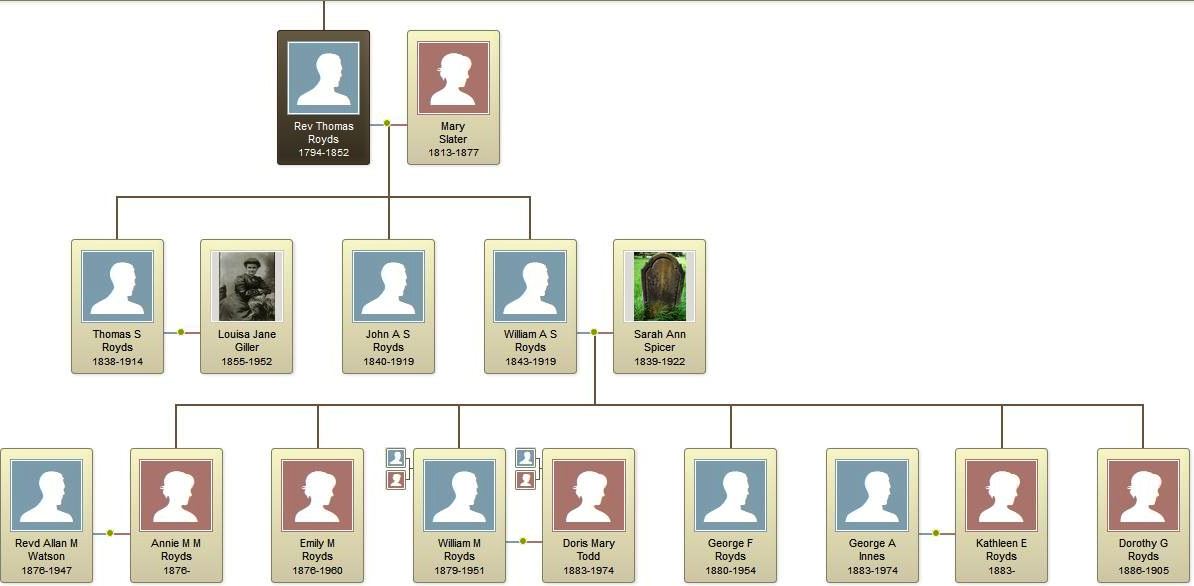
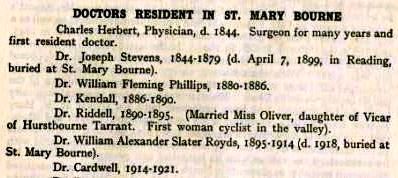
Dr William Alexander Slater Royds: Community Pillar and Successor to Dr Stevens

Cricket team SMB 1906 main pic 001

Village Cricket Team 1906 courtesy HG

TitleNamesThe St Mary Bourne cricket team for 1906 look remarkably glum for a group of people who had just won the village league challenge cup. Perhaps the photographer was one of those annoying professionals who spend so long  perfecting their work that they have long since left their sitters behind in a slough of despond.

Dr Royds, as the president of the cricket team, sits in the centre of the group, looking as thoughtful as any. Perhaps he was thinking of his daughter Dorothy, who had died just the year before at the age of nineteen. Perhaps he was thinking of his son William, who had apparently taken to heart the injunction ‘Go West, Young Man’, and seemed destined for a life in the Americas. Royds family


Or perhaps he experienced one of those sudden presentiments – within ten years most of the young men surrounding him would be at the Front, fighting for their country and their young lives.

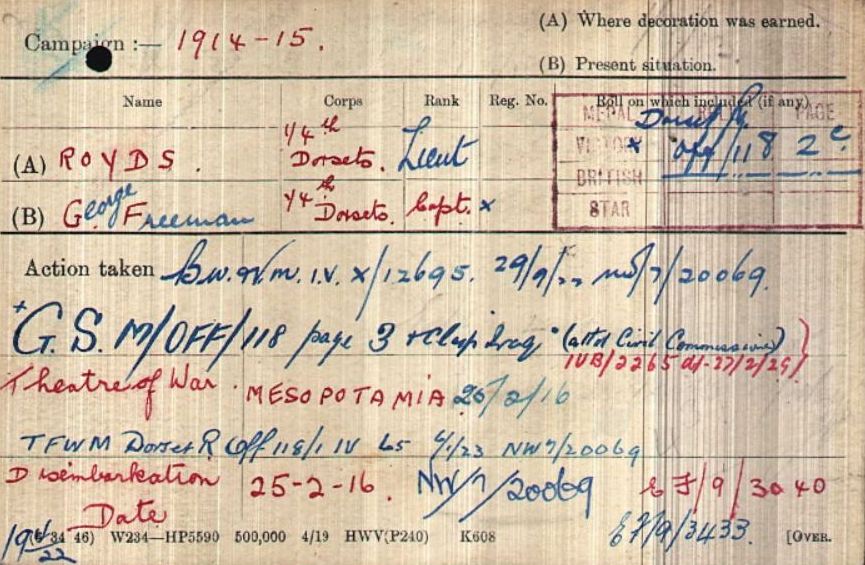
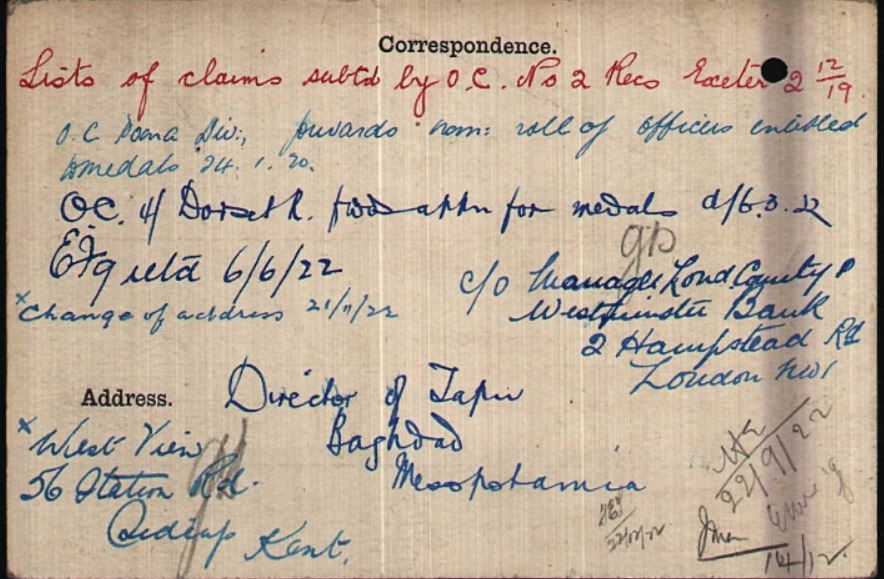
One of those who would go to war was his own son, George Freeman Royds, who  in due course would have a distinguished war in Mesopotamia, but as a professional soldier had been in at the start.

George Freeman Royds 2nd Lt

Capture

abaHe considered himself lucky, in a way, to have the compensations of his profession to keep him from dwelling too long on the sadnesses of his life – there were too many things to be done and people to be attended to.

dOCTOR'[S HOUSE KATHLEEN INNES vILLAGE STORY

Extract from ‘A Village Story’ by Kathleen Royds Innes 1955

SMB doctors by KaTHLEENB INNES ST M B RECORDS

Extract from ‘St Mary Bourne Records’ by Kathleen Royds Innes 1947

Portway

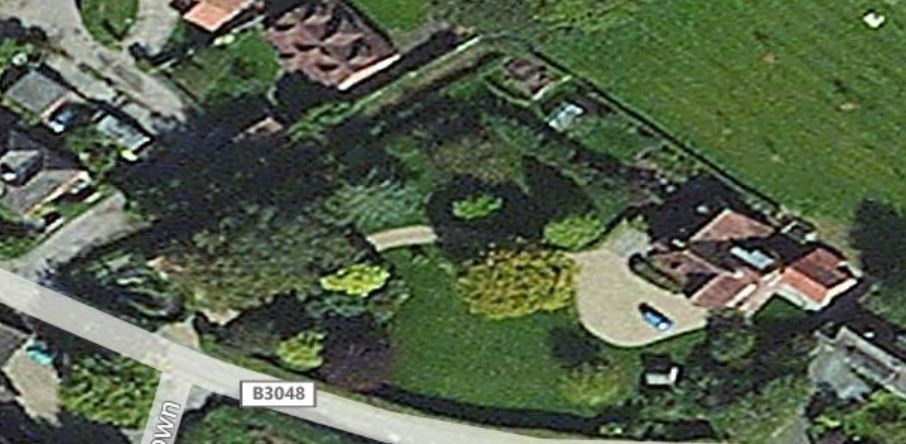
Post script: WRONG HOUSE! This is where Dr Royds’ daughter lived on marriage to George Innes, not the Doctors’ house – see post of 7 December 2014 https://stmarybournegoestowar.net/2014/12/07/led-up-the-garden-path-by-laurus-nobilis/


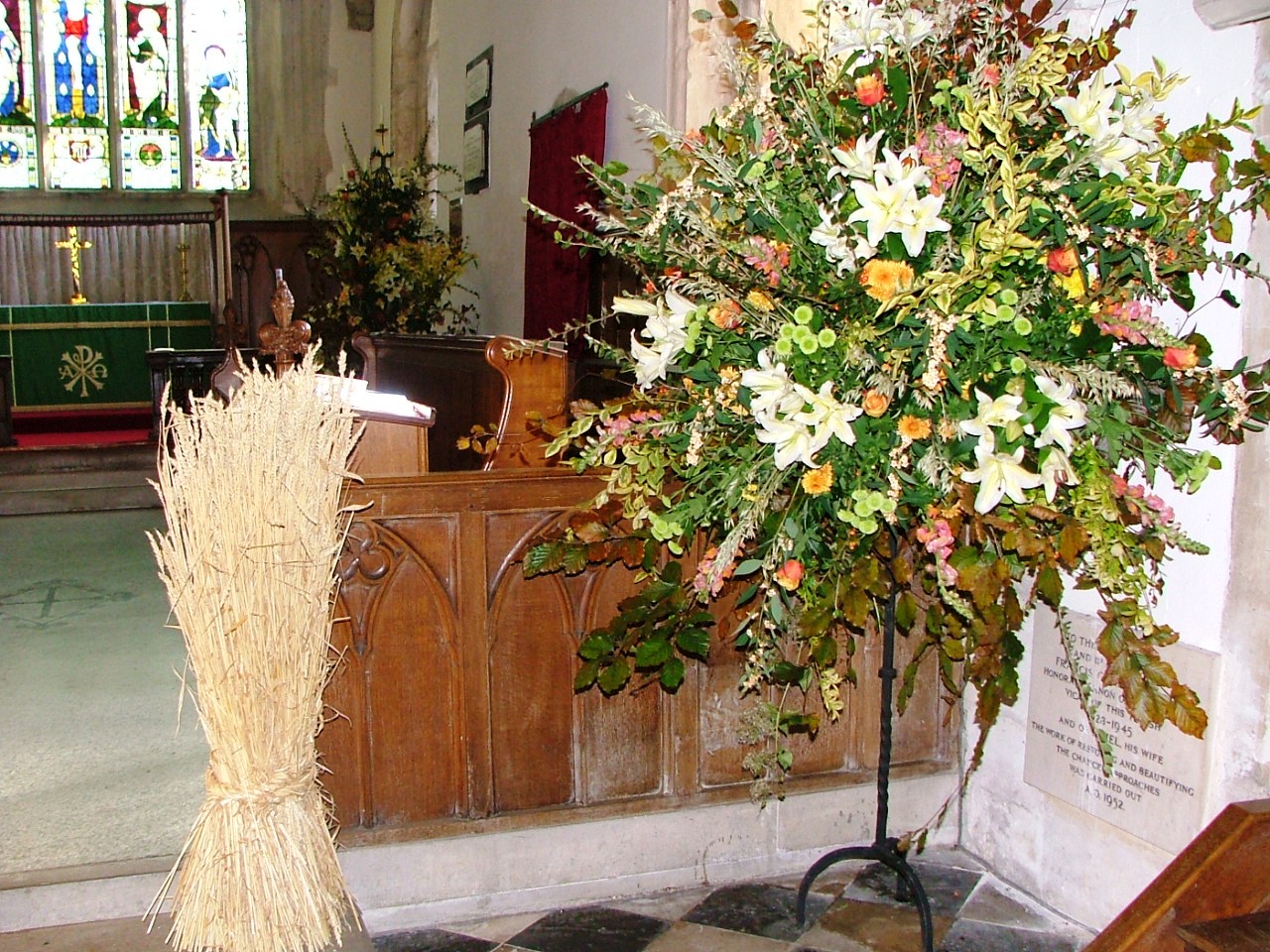
Church Flower Ladies – And One Or Two Men

SMB Harvest 2004 005

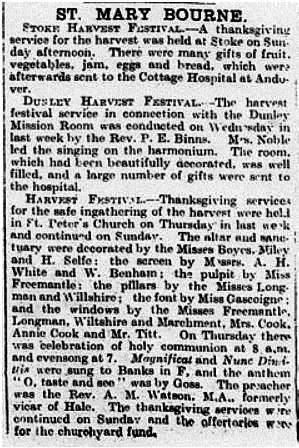
Andover Advertiser 2 October 1914

Andover Advertiser 2 October 1914

The Primitive Methodists may win out in the provision of food and cups of tea, but when it comes to church flowers, it is hard to dislodge the Church of England from her pedestal. The person who explains this best is Barbara Pym, as she does here:

It was a Saturday morning … it was the usual gathering, Winifred, Sister Blatt, Miss Enders, Miss Statham and one or two others. The only man present, apart from the clergy, was Jim Storry, a feeble-minded youth who made himself useful in harmless little ways and would sometimes arrange the wire frames on the window-sills for us or fill jam jars with water….‘Well, well, here we all are,’ said Julian in a rather more clerical tone than usual. ‘It’s very good of you all to come along and help and I’m especially grateful to those who have brought flowers. Lady Farmer,’ he mentioned the name of the only titled member remaining in our congregation, ‘has most kindly sent these magnificent lilies from her country home.’…We went into the church and began sorting out the flowers and deciding what should be used where. Winifred, as the vicar’s sister, had usurped the privilege of a wife and always did the altar, but I must confess that it was not always very well done. I had graduated from a very humble window that nobody ever noticed to helping Sister Blatt with the screen, and we began laboriously fixing old potted-meat jars into place with wires so that they could be filled with flowers. Lady Farmer’s lilies were of course to go on the altar.

So what does this allocation of duties at St Peter’s on 2 October 1914 reveal? Well, St Peter’s of 1914 and Barbara Pym agree on the pecking order: Altar, Screen, Windows.

Altar and Sanctuary

Miss Boyes

Margaret Angela Boys, daughter of Sir Charles Vernon Boys (of whom much more later) and Marion Pollock, Lady Boys
.

Miss Miley

Grace Virginia Miley, daughter of Miles Miley and Lucy Boys (and first cousin of Margaret Boys)

Miss H Selfe

Hilda Selfe via ancestry.co..uk, courtesy Barbara Hockmeyer

Hilda Selfe via ancestry.co..uk, courtesy Barbara Hockmeyer

(Ann) Hilda Selfe

Screen


Mr A H White

Albert Henry White of Barford House.

Mr W Benham

Possibly William Henry Benham, a gardener

Pulpit

Miss Freemantle

Probably Lucy Freemantle, 73-year old spinster, helped by her niece, Jessie?

Pillars

Miss Longman

Either Georgina Blanche or Maggie Gertrude, spinster daughters of William Longman, builder and undertaker, of Link House, and his wife Mary Ann.

Miss Willshire

Presumably Laura Willshire of The Plough Inn

Font

Miss Gascoigne

Catherine Anne, 49 year old housekeeper from Northamptonshire working at Diplands.

Windows

Miss Freemantle

Presumably Jessie Freemantle, aged 43, niece of Lucy Freemantle for whom she acted as housekeeper

Miss Longman

Either Georgina Blanche or Maggie Gertrude, spinster daughters of William Longman, builder and undertaker, of Link House, and his wife Mary Ann.

Miss Wiltshire

(not known)

Miss Marchment

Anne or Ellen, daughters of Henry Marchment of Middle Wyke

Mrs Cook

Sarah Cook, wife of John, a farmer?

Annie Cook

(not known)

Mr Titt

James Titt, agent for the Hampshire & General Friendly Society

That is pretty much in line with the Order of Precedence– (daughters of knights at the top, insurance salesmen at the bottom) combined with a shrewd village assessment, crafted over the centuries, of the precedence of an elder daughter of a builder in relation to the younger daughter of a farmer. The decision depends on the size of the building business/farm, number of employees, and length of residence in the village. Also, of course, the degree of friendliness with the supervisor of the flower ladies…


Laura The Landlady: by Win Bourne

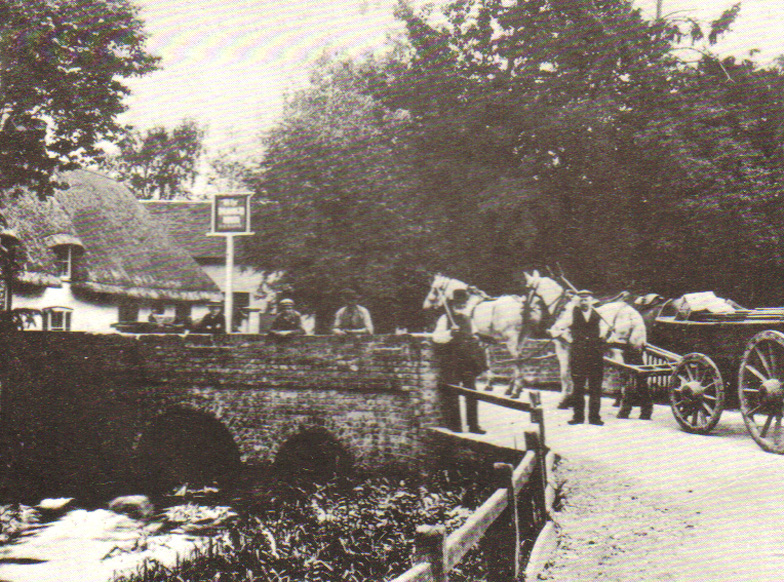
The Bridge c1925

James Willshire had been running the alehouse The Plough for several years with the help of his wife Margaret, who was four years older than him. He had been an innkeeper and master brewer for many years;  his father had taught him the brewing trade, which he had combined with being a cooper.willshire 1911Now in his sixty-third year and with his legs not so good, James was still able to change the barrels when needed, putting full barrels on the racks and taking the empties out to the store at the back of the pub. He sat each evening with his one pint, along with the other old regulars, puffing away on their pipes and discussing the harvest- the cost of feed etc. and other village gossip.

James and his wife Margaret had worked together all their married life, and, as their two sons Victor and Ernest had left home to follow their own careers, they decided to train Laura in the art of innkeeping, enabling them both to take life a little easier. Laura had done well at school and was quick with numbers. She was friendly and polite and very willing to learn. Initially Margaret kept Laura behind the counter, teaching her how to pull a pint, how to measure a spirit drink and, most importantly, how to deal with customers.

“Always be ready to listen when a customer feels like talking, but never offer your own opinion”, was one of her maxims.  “Never repeat what one customer says, to another”, was another. “Let them do the talking and you do the listening”, she would advise. Then she might promptly lean on the bar and whisper to a customer “did you hear that…….”

Laura, now 26 years old,  ran the inn almost singlehandedly, though of course her father was still the owner.  She employed a pot man; though employed was not quite the correct description for their arrangement – he would collect the empty pots and jugs from the tables in the bar and outside in the yard, and also sweep up the sawdust after closing time and lay fresh for the next day – as payment she gave him a free pint of ale with some bread and cheese each midday and maybe a bowl of broth for dinner,  so he was grateful for her generosity. Not that you would know this, as he was a morose old man with very little to say and grunted replies to anyone who spoke to him.

The young lads of the valley often gathered on the bridge on the square after their various days’ work, mostly still in their working clothes and heavy boots, the smithy’s apprentice with his shirt spotted with burn marks from the forge, the thatcher with bits of straw in his hair or poking from his cap, and the stable hand smelling strongly of horses.

Their most popular conversation was in which of the armed forces they would prefer to be enlisted,  which regiment or battalion they would choose. Some wanted to be with the horse, some with the rifle, and some on the high seas. All were very keen, as soon as they reached the age of 18, that they would be off to the Drill Hall in Andover to collect the King’s shilling. The older men sitting outside the ale house would listen, saying nothing. Their memories of their time in the Second Boer War, nay some even in the first, and the horrors they saw and maybe suffered there, were etched in their brains and carried heavily in their hearts.

How could they pass that knowledge and experience on to these young men? To persuade them that war might not be the great adventure they all dreamed of. They knew they couldn’t, so the old chaps carried on puffing their pipes, chewing their baccy and drinking their beer.


Notes

-James Willshire is shown in the 1911 census as occupying The Plough, having been the proprietor of a pub in Bradford on Avon in 1901; he is still there in the 1912 trade directory but at some point before 1920 he had moved again, this time to The Railway Inn (now The Bourne Valley Inn).

-We do not know the identity of ‘the pot man’ but The Plough was used by the farmers and was a busy pub at the centre of the village. Laura would not have been working on her own and the employment of a pot man seems a reasonable inference.

The Conservation Area Description says:

The Old Plough, formerly an inn, dates from 17th and 18th century. Although only of one-storey and attic, the significant length of the building is emphasised by its steeply pitched, long thatched roof slopes, and simple elevational treatment. Of intrinsic architectural merit, its location at the river crossing, and its dominance of views through the space, makes it a key building in the Conservation Area.

The photograph of The Plough, behind the bridge over the Bourne, is again one of those that came to me without indication as to copyright owner. If this is you, please contact us in the comments below so that we can properly acknowledge you or, if you prefer, remove it from this blog.

Our New Contributor

This is the first of what we hope will be many posts by Win Bourne, a ‘member’ of our history group. Thank-you, Win!

Win


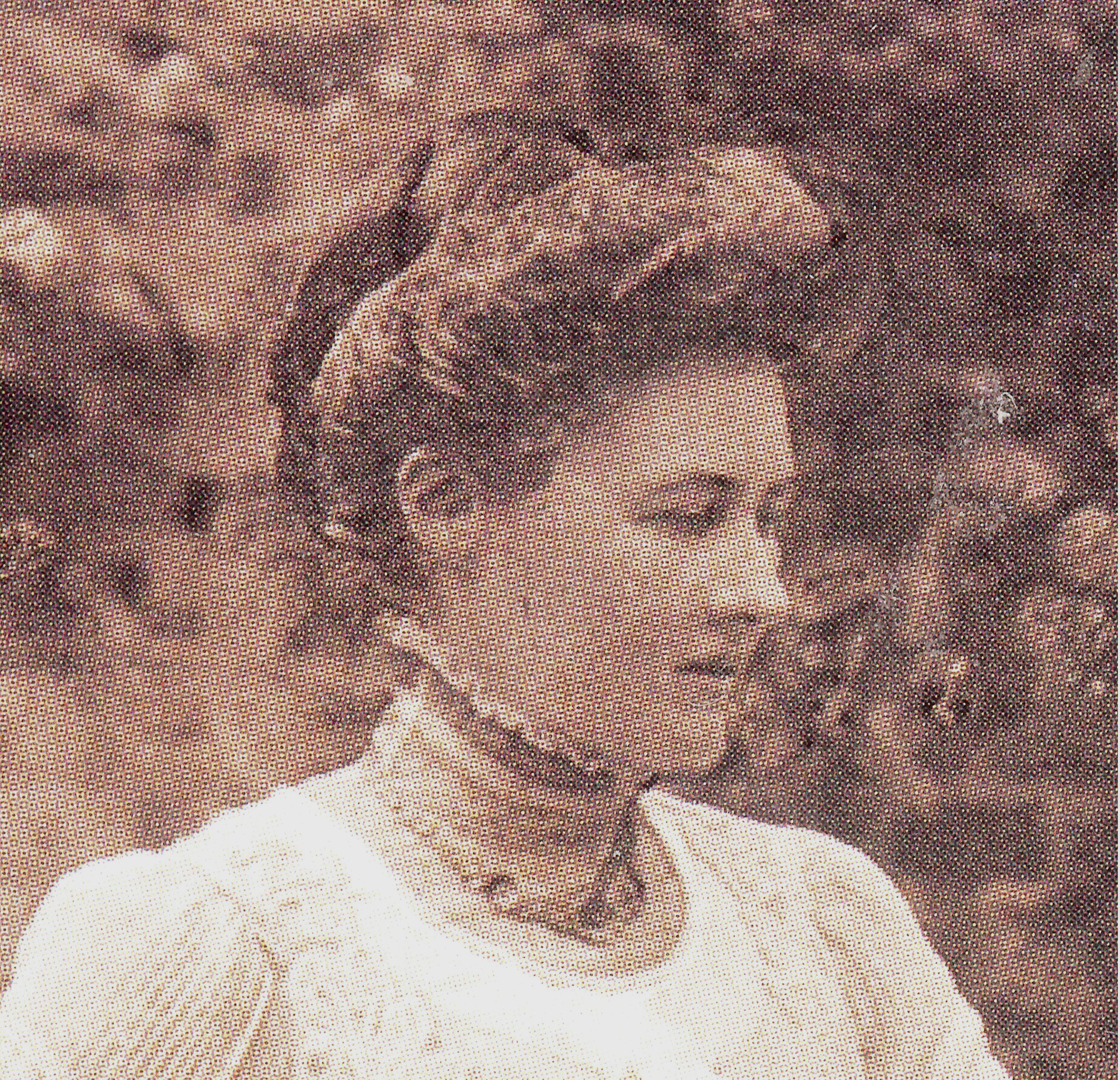
Beatrice Mary Pease Wallop, Countess of Portsmouth

Beatrice 001

Lady Portsmouth, extract from a photograph of the earl and countess in the history of the Earls of Portsmouth and the Wallop Family by Alison M Deveson. http://www.amazon.co.uk/En-Suivant-Verite-History-Portsmouth/dp/0955824400

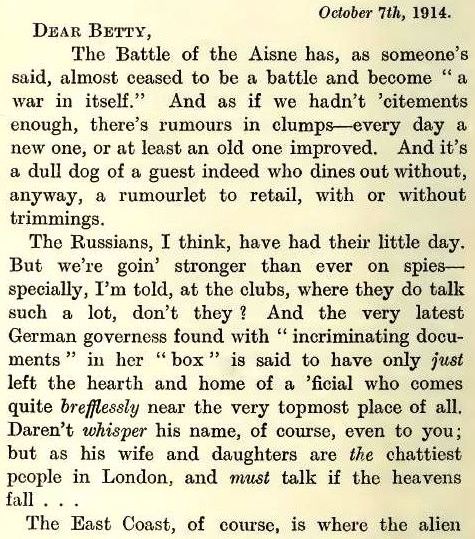
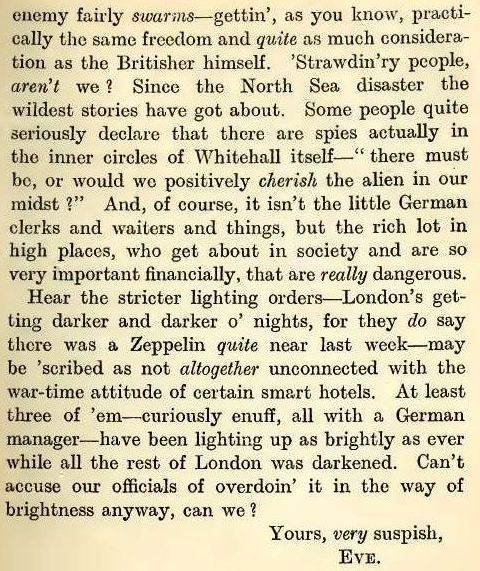
Lady Portsmouth flung down her copy of Tatler, exasperated by the veneer of fluffy flapper femininity some editor had presumably thought necessary to overlay on the writing of Olivia Maitland Davidson, a perfectly intelligent girl (one of the Gloucestershire Viners) who was entirely capable of writing an interesting article without the word ‘excitements’ having to be rendered as ‘ ‘citements’. Really – how patronising!

The letters of Eve Nov 1914 2 - CopyEve 7 October 1914Eve 7 October 1914 - CopyOlivia was writing these letters every week, and they were really quite entertaining, even if Lady Portsmouth inevitably found herself wincing at the winsomeness.


Beatrice Mary Pease (1866-1935) was one of THE Peases, that is to say the Quaker family of industrialists and philanthropists that built the Stockton-Darlington railway, amongst many other achievements. After her father Edward’s death in 1880, she was given a home by her uncle, Sir Joseph Pease until her marriage to the 6th Earl of Portsmouth. We shall hear much more of her.

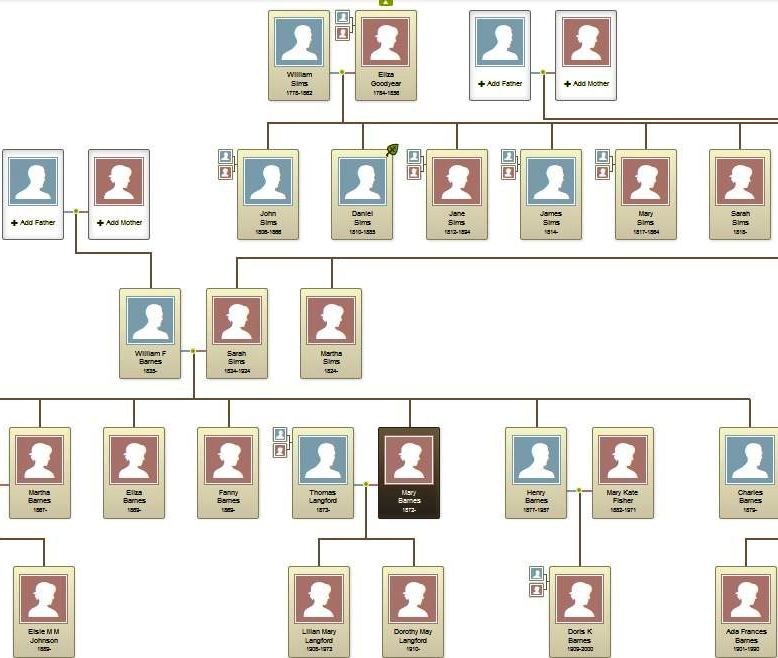
Mary Barnes Langford

Sims treeMary Barnes Langford, the daughter of William Barnes and Sarah Sims, was very glad indeed of her sisters, and her cousins, and her aunts surrounding her in the village, as she would otherwise have felt very lonely indeed.

She had just seen her husband, Thomas, off to war. They had been married seven years, and had two daughters, Lillian and Dorothy, who were now five and three years old. They couldn’t understand what had happened to their father, but they were bewildered and seemed to spend a lot of time squabbling with each other. She realised that this was probably partly because of her own mood, which was anxious and sad. Sad of course because she missed her husband, but anxious because she could not see how they were going to make ends meet.

sims 1911 censusThank goodness for her mother, who had lived with them ever since they came to Ivy Cottages. At 79 years old, she was not really up to looking after the girls single-handed if she could find work, but that might be what was needed. Perhaps she could find work she could do at home, taking in people’s laundry or something.

Ivy Cottages

Ivy Cottages, Link (near Bourne Valley Inn on the valley road)

Mary was in that annoying state where she couldn’t quite manage to cry, but couldn’t quite pull herself together either.

‘Remember you are a Sims!’, she said to herself, in an attempt to reach deep within to draw on her famous family toughness. Why, her great-uncle Daniel Sims* was the St Mary Bourne equivalent of the Tolpuddle Martyrs!

Great Uncle Daniel had been a worthy follower of Captain Swing

When 19th c. politicians and pamphleteers spoke of the English ‘peasants’, they did not mean direct family cultivators, but agricultural wage-labourers. In fact the English agricultural population divided into three – at the top stood a small number of landlords, who between them owned most of the land. The first attempt to discover how the land of Britain was owned (in 1871-3) revealed that about 1200 people owned ¼ of the UK, and about 7,200 owned ½ though it certainly underestimated the concentration of landed property…

This comparative handful of giant landlords rarely cultivated their estates themselves…they rented them out to tenant farmers who actually exploited them. In 1851, when the first nationally reliable figures were collected, there were about 225,000 farms in Britain, about ½ of the 100-300 acres in size and all of them averaging just over 110 acres, ie what passed for a small farm in England would certainly have counted as a giant farm beside the smallholdings of typical peasant economies. Just over 300,000 described themselves as farmers and graziers, who cultivated their farms b y employing the 1.5 million men and women who described themselves as agricultural labourers, shepherds, farm servants etc, ie the typical English agriculturalist was a hired man, a rural proletarian…

Of course rural society consisted not only of those actually engaged in land ownership or farming, but also of the numerous craftsmen, shopkeepers, carters, innkeepers etc who provided the services necessary to agriculture and village life…


It was in Hampshire and Wiltshire that the movement, as it drove westwards, became the most widely dispersed and attained its greatest momentum. When the riots were all over, there were 300 or more prisoners awaiting trial in each county, compared with a little over 160 in Berkshire and Buckinghamshire and a little over 100 in Kent. Yet in both [counties] the riots were remarkably short-lived.

[As reported in The Times of 27-29 November 1830], Hampshire, Berkshire and Wiltshire were chiefly concerned with machine breaking [whereas the other counties were chiefly fire-raising]. In Wiltshire, it was said of the small farmers that, even if they did not actually take part in the riots, they are ‘glad to see the labourers at work’ and many farmers were half-hearted in the defence of their machines and made the labourers’ task an easier one. Their hostility to tithe and rent was deeper and led them, on occasion, to become active accomplices.


18 November 1830 St Mary Bourne Arson attack on large farmer – ricks were fired, setting off riots in the area
21 November 1830 Vernham Dean A ‘robbery’, ie acquiring money or food by menace
21 November 1830 Hippenscombe Threshing machine destroyed
22 November 1830 Ashmansworth Villagers compelled their rector to pay them 2/-
22 November 1830 Hurstbourne Tarrant ‘Robbery’ to the value of £1
22 November 1830 Vernham Dean ‘Robbery’


Between 18th and 24th November 1830, there were incidents in Andover, Barton Stacey, Broughton, Bucklebury, Buttermere, East Woodhay, Great Bedwyn, Ham, Highclere, Hippenscombe, Houghton, Hungerford, Inkpen, Kintbury, Lambourn, Leckford, Ludgershall, Mottisfont, Overton, Stockbridge, the Wallops and Upper Clatford.[i]


Thomas is believed to have been part of the Territorials called Hampshire Fortress:

The following is a list of units transferred to the Territorial Force on 1 April 1908, or raised in that year under the terms of the Territorial and Reserve Forces Act 1907, and the associations by which they were administered.[1] … A number of units, particularly those attached to the Royal Garrison Artillery and Royal Engineers, had their titles altered again in 1910.[2]

Hampshire (Fortress) Royal Engineers (Nos. 1, 2 and 3 Works Companies, Nos. 4, 5 and 6 Electric Light Companies)

*Daniel Sims is on the tree – and marked with a small green leaf in the corner. His transportation to Australia with his “co-conspirators” is covered in Julie Muirhead’s blog post here.

[i] Captain Swing by E J Hobsbawm and George Rudé, Lawrence and Wishart 1969

The Holbrookes of Stoke House

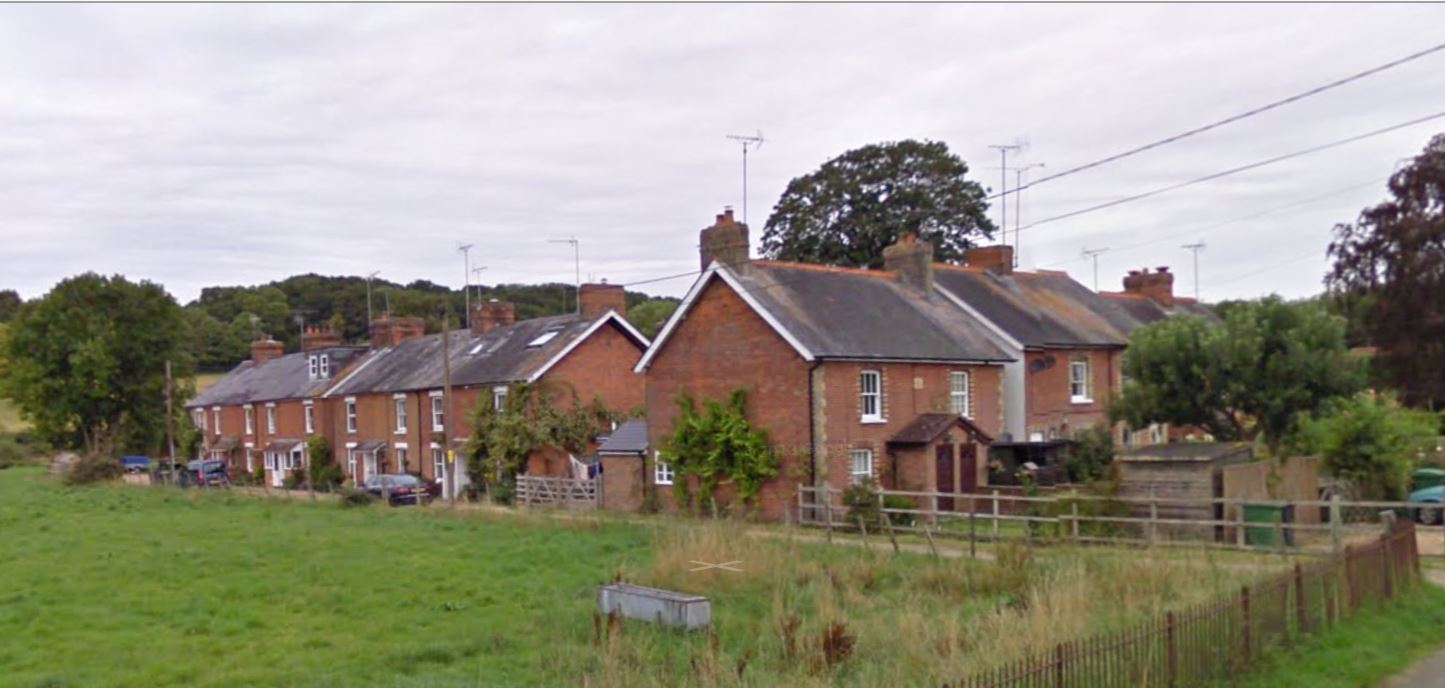
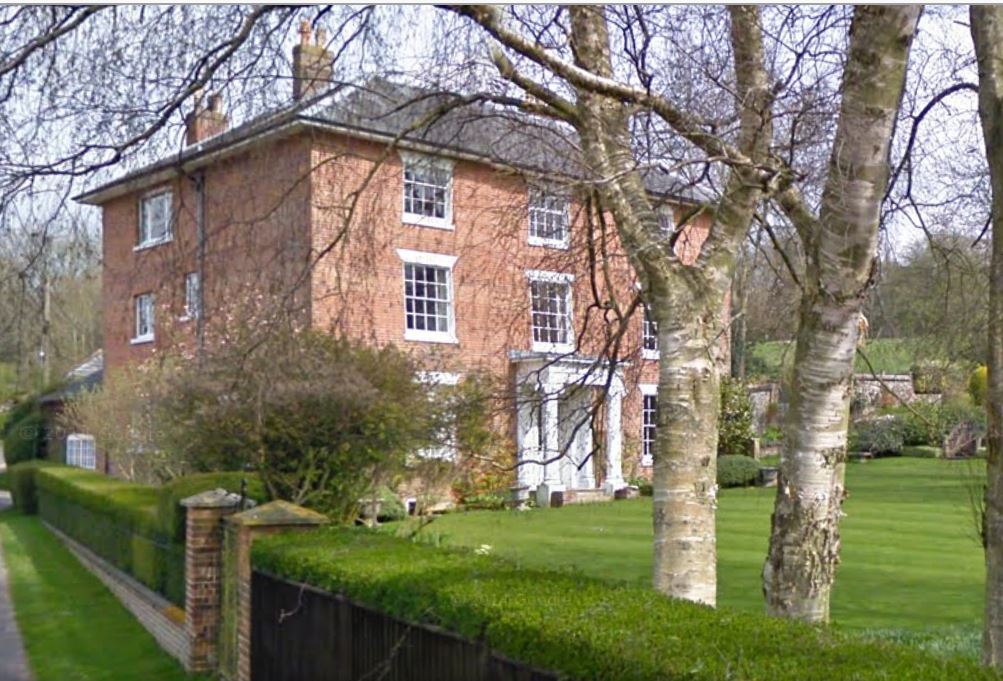
Stoke House

Stoke House via Google Street View

Barbara Holbrooke sat in her morning room, drew a deep breath and wondered what she should attempt next, apart from the Herculean task of marrying off her three remaining spinster daughters. Gertrude and Constance were both happily married, thank goodness, but Winifred was now 46, Helena 44 and Margaret had just turned 30. They were not unattractive girls -women- but the problem had been finding young men brave enough to propose to the daughters of  the vicar. And Kimpton, with a population of only 300, where they had lived from 1882 until her husband’s death in November 1911, was the very epitome of being a large goldfish in a very small bowl – where on earth was she supposed to have found eligible bachelors for them?
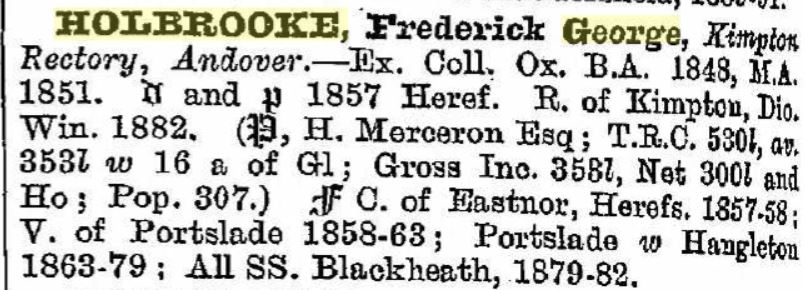
Despite the small size of the parish and congregation, the rectory was positively palatial – 16 rooms in the way counted by the 1911 census. As the living remained in the gift of the local landowner, she presumed that the lord of the manor had financed both church and rectory without input from the diocese, with the idea of putting a succession of second or third sons in this sinecure.

Crockfords 1908

It was not, of course, a surprise that her husband had predeceased her – after all, he was 22 years her senior. But it had been a bitter blow when their youngest son, Lt Dr. Cecil Dacre More Holbrooke, had died while serving in the army in India in 1909. She had hoped that, by steering him into medicine, he would escape the apparently irresistible pull of the scarlet  (none of their children seemed to be drawn to the black of the ecclesiastical world). But it was not to be. In 1905, at the age of 25, he had joined the RAMC and been sent to Poona where he had met his end, four years later, in a chukka of polo hit on the head by the ball.*

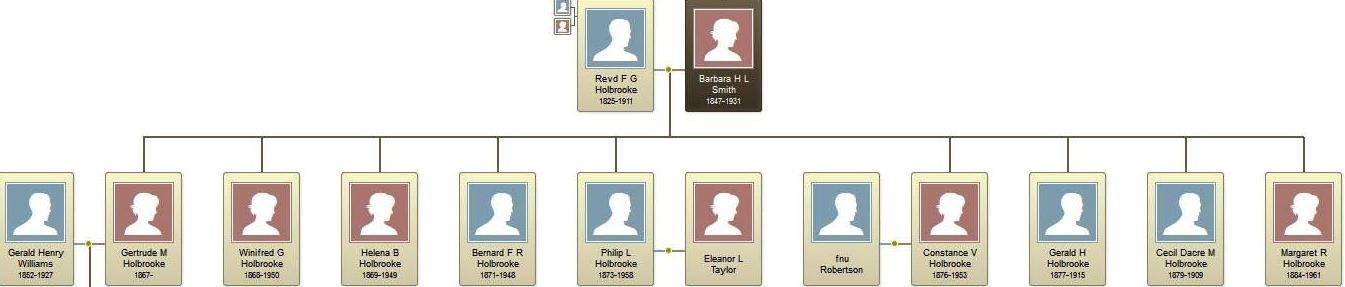
Holbrooke tree

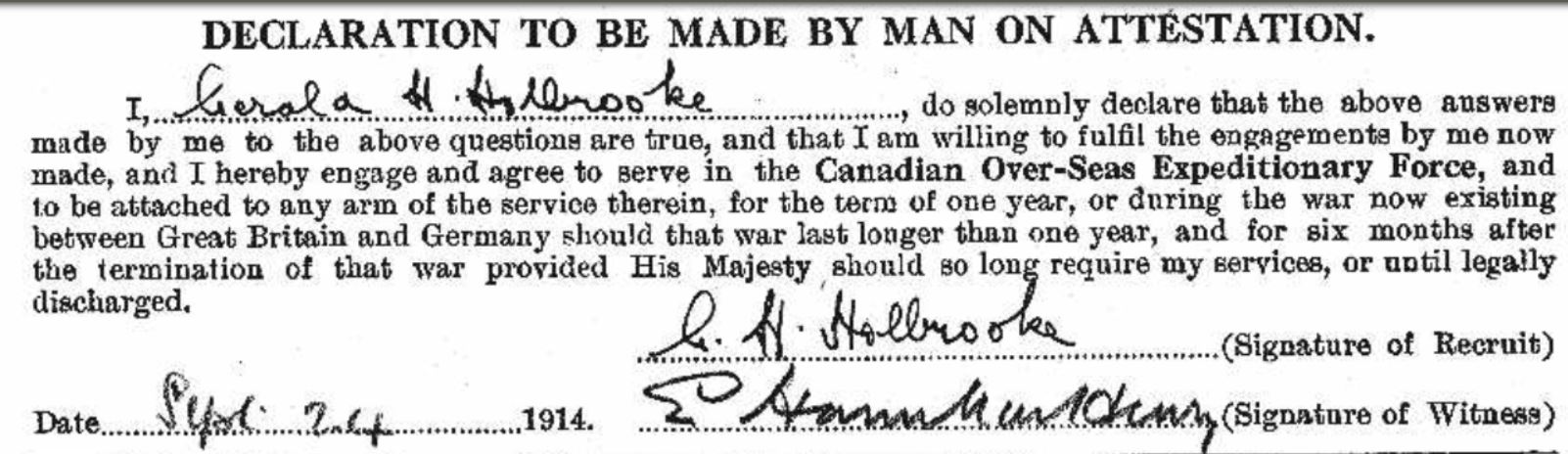
Her three remaining sons had also gone into the army. She had had hopes that Gerald Howard, born in 1877, who emigrated to Saskatchewan in 1909, would also escape a military fate. He was indeed just getting himself established when war was declared in Britain so, of course, he duly signed up in Canada on 24 September 2014.*

Attesty

Gerald had already served 5 years with the 12th Middlesex, eight years with the Natal Police, and two years with the (Canadian) Royal North West Mounted Police.

In 1870, the vast area known as Rupert’s Land was transferred from the Hudson’s Bay Company to the new Dominion of Canada. The sudden shift of authority and resultant uncertainty and unrest among the inhabitants of the region erupted into the Red River Rebellion of 1869-70. Alarming reports of whisky trading and of restlessness and inter-tribal warfare among the Indians of the plains reached the newly formed federal government in Ottawa. It was essential that order be restored and maintained if the Canadian Northwest was to attract settlers. In 1872, Colonel P. Robertson-Ross, Adjutant-General of the Canadian Militia, was dispatched into the Northwest on a fact-finding journey for the Canadian government. He recommended that a regiment of 550 mounted riflemen be organized to preserve order in the territory and to protect the surveyors and railway builders who were working their way to the Pacific coast.

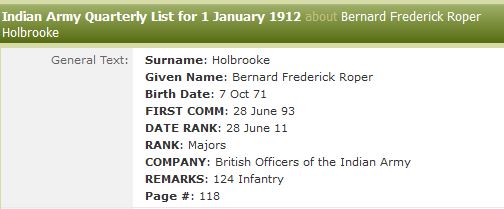
aaTheir eldest son, Bernard Frederick Roper, had joined the Indian army in 1893 at the age of 21 – she remembered that there had been no holding him. It was a good life for a young man, just so long as they weren’t engaged in any war. She dreaded what the future might be for him now.

aaa


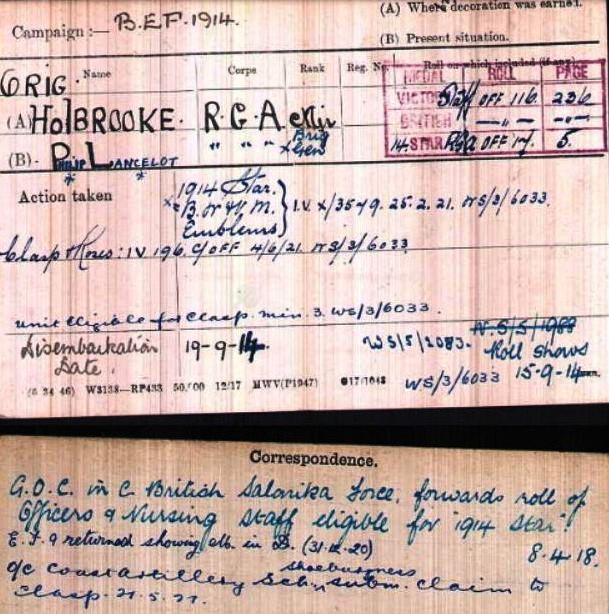
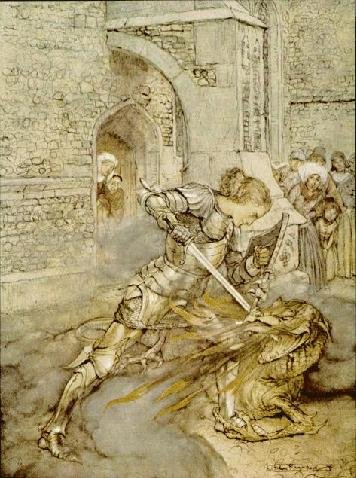
But the very first to arrive at the front had been, as she might have known, her knight in shining armour, Philip Lancelot. Although he was 41 years old by now, he arrived in France with the Royal Garrison Artillery as part of the British Expeditionary Force on 19 September. He had left behind a wife, Eleanor, whom she would have to keep an eye on, although she was perfectly looked after by the army, living in married quarters in Shoeburyness with a cook and a maid, and plenty of other wives for company.

Her life felt as if all the colour had gone out of it. She knew she must make an effort to keep up the spirits of her daughters, but today her heart was not in it. She already hated this phrase people kept using, ‘for the duration’. How long, oh how long might that be?


Notes.

*I have seen – but cannot at the moment lay my hands on 😦 the evidence for the polo accident. Apologies, but I did not want to delay this post any further.

I have concluded that my memory may have been playing tricks – Captain Egerton Orme Bellairs Black Hawkins (see elsewhere on this website) is memorialised at the military cemetery in Bloemfontein and St Mary Bourne (Section G Row 10 #406) ‘killed 21 January 1909 in a polo accident’. Grateful thanks to the commenters below.

**The evidence for the Holbrookes having moved to Stoke House is Gerald’s attestation papers in September 1914, when he gives his mother as his next of kin.

The Long Shadow Of Camelot: The Holbrookes

Historical events are said to cast a long shadow, and today, if you will join me on a journey, our Tardis takes us back to the arrival of William, Duke of Normandy, on our shores in 1066 or, if you prefer, all the way to Camelot.

Amongst William’s companions was the Count of Rupierre, ‘Rubra Spatha’ or ‘Red Shield’, to whom he gave a chunk of Derbyshire in gratitude. Over the years, the most successful 1 of these Ropers moved to Kent where Will Roper married Margaret, daughter of Thomas More. Skipping a few centuries, we arrive at Henry Roper, 10th Lord Teynham, of Linsted Lodge (1708-1781), who begat Philip who married Barbara Lyttelton by whom he had a son and six daughters, one of whom (Emma Theresa) married Frederick Holbrooke, whose family were gentlemen (as described in his father’s will proved in 1808) and may be descended from the 15th century astronomer and Master of Peterhouse, John Holbrooke. 2

Frederick and Emma Holbrooke in turn had  five daughters and one son, the Revd Frederick Holbrooke, who married Henrietta Smith. They had six daughters and four sons: Bernard Frederick Roper (1871-1948), Philip Lancelot (1873-1958), Gerald Howard (1877-1915) and Cecil Dacre M (1879-1909).3

Dear reader, armed just with the above information, I ask you to infer what happened to the four sons and why. I pause, and invite you to do so also.


1770599

Shall we start with the why?


Much has been written about the influence of the public schools (The battle of Waterloo was won on the playing fields of Eton) and poets like Sir Henry Newbolt and his Vitai Lampada  in fostering a spirit of gung-ho militarism at the end of the 19th and beginning of the 20th centuries.


This is the word that year by year
While in her place the School is set
Every one of her sons must hear,
And none that hears it dare forget.
This they all with a joyful mind
Bear through life like a torch in flame,
And falling fling to the host behind –
“Play up! play up! and play the game!”


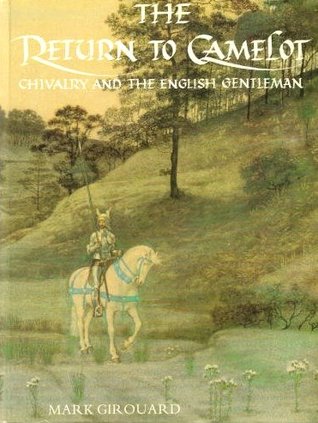
Although I am sure this is true, I think there was another equally important factor: the revival of the code of chivalry, as summarised by this reviewer 4 of Mark Girouard’s book5

Around about the time of its wars against the French Revolution and then Napoleon, England witnessed an odd and interesting phenomenon that lasted through the entire 19th century and right up to the end of the Great War: The revival of the medieval code of chivalry, with King Arthur, knights in armor, the notion of courtly love, and all. The ideals of personal bravery and honour, service to the nation, and self-sacrifice reappeared in modified form and helped shape British culture for several generations, not only in art and literature but even in politics.

Sir Walter Scott’s novels had a lot to do with reviving the myth of chivalry (and it was indeed mostly a myth), and so, too, did the paintings of Benjamin West, featuring the Black Prince and other knightly heroes. And Tennyson helped further the new myth in the next generation. There was a new rise of interest in the Middle Ages, but George IV and then the Victorians interpreted that period to suit themselves. Those with the money to build new country homes often opted for what they fancied were medieval-style castles. Prince Albert’s tomb features a reclining sculpture on top depicting the Prince in full armor with his favorite dog at his feet, also in medieval funerary style. Even Baden-Powell promoted his new Boy Scouts in Arthurian chivalric terms.

The whole thing reached its climax with the deaths of Capt. Robert Scott and his companions in Antarctica early in 1912 (especially Capt. Oates, who “walked out to his death an English gentleman”) and with the sinking of the TITANIC later that same year. Many of the English males aboard politely helped their wives and other women into the lifeboats and then stepped back, content to go down with the ship… And just to round out 1912, there was also a jousting tournament at Earl’s Court, in which a dozen aristocrats donned armor and went at each other with lances.


And as for the what?
For that, dear reader, you will have to wait (not too long, I promise) for the next episode 🙂
But the connection with St Mary Bourne, I will tell you, is that for many years the Revd Frederick Holbrook was Rector of Kimpton, and that after his death his widow and the remaining children living at home moved to Stoke House.


1 My knowledge of the Roper family lies in my own descent from the ‘no-hoper Ropers’ (sorry, cousins!) who remained in Derbyshire and did not go on to make a fortune.

2 see Oxford University Press Keith Snedegar, ‘Holbroke , John (d. 1437)’, Oxford Dictionary of National Biography, Oxford University Press, 2004 [http://www.oxforddnb.com/view/article/13482, accessed 4 Oct 2014] John Holbroke (d. 1437): doi:10.1093/ref:odnb/13482 ]

3 As we have seen, Roper was one of the landed gentry families of England. Lancelot was a knight of the round table, The family name of the Barons Dacre is Trevor-Roper, and the Dacres married into the Howard family, who became Dukes of Norfolk.
4 Review of Mark Girouard book

5 See The Return to Camelot: Chivalry and the English Gentleman by Mark Girouard

‘Tipperary’: The Western Front And The Home Front United In Song

The mood in Henry Fisher’s refreshment rooms that morning (the part of it reserved for the men) was a little downbeat. The war had not been going for two months yet, but no one now seemed to think it would all be over by Christmas.

The chaps had fallen to talking about what they would normally be doing on the first day of October. There was a pleasantly seasonal nip in the air which reminded them that today signalled the start of pheasant shooting and there was nothing to prevent them except a general feeling that it would be in poor taste to engage in shooting for sport at a time when the lads were at the front, shooting for their lives.

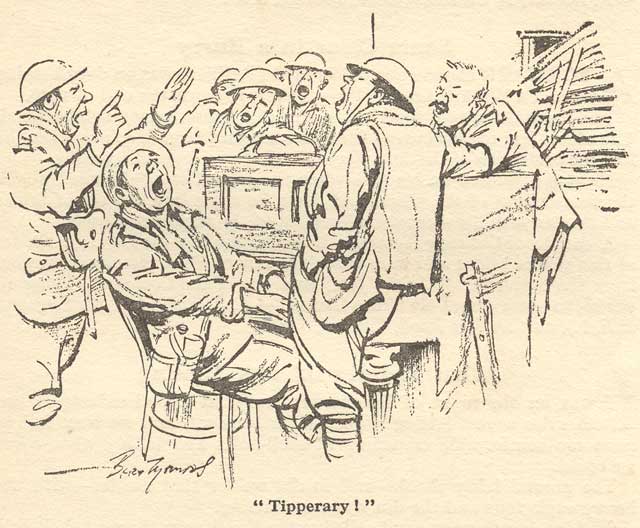
‘Come on, fellows, this won’t do!’, said Albert White of Barford House, going to the piano and striking up the new tune, which everyone seemed to be humming or whistling these days – whistling in the dark, perhaps, but still effective.

Tipperarytitlethis morning's gossip

"Tipperary!" (click to enlarge)

The Guns’ Obligato*

The day after the Canadians attacked Vimy Ridge my battalion of the Royal Fusiliers advanced from Bully Grenay to a chateau on the outskirts of Lieven under heavy shell fire.

At the back of the chateau a street led to the main road to the town.  There, despite the bombardment, we found a Cockney Tommy of the Buffs playing “Tipperary” on a piano which had been blown out of a house into the road.

We joined in – until a shell took the top off the chateau, when we scattered!

L.A. Utton, 184 Coteford Street, Tooting, S.W.


You may have seen Gareth Malone’s explanation of the popularity of Tipperary, in which he says:

On the Western Front, marching bands were sent to accompany the troops. Soldiers would regularly put on concert parties and almost every division had its own entertainment troop. In the long periods of waiting between battles, songs played an important role in staving off boredom and boosting morale.

‘A Long Way to Tipperary’ was the first hit of the war – a lively tune with fond thoughts of returning home soon. Songs about home resonated throughout the war, with ‘Keep the Home Fires Burning’, released in 1914, remaining popular throughout. As war continued, upbeat messages about staying cheerful and carrying on, such as ‘Pack Up Your Troubles’, played a vital role in keeping spirits up. The songs united people in a shared experience whether they were at home, on the Western Front or stationed further afield.


*Extract from

Memoirs & Diaries – The Best 500 Cockney War Stories – Not Yet Blasé and Other Stories

Published in London in 1921, The Best 500 Cockney War Stories comprised, in the words of its newspaper publisher (The London Evening News) “a remembering and retelling of those war days when laughter sometimes saved men’s reason”.

via First World War.com


All Is Safely Gathered In By The Primitive Methodists

Harvest Field by

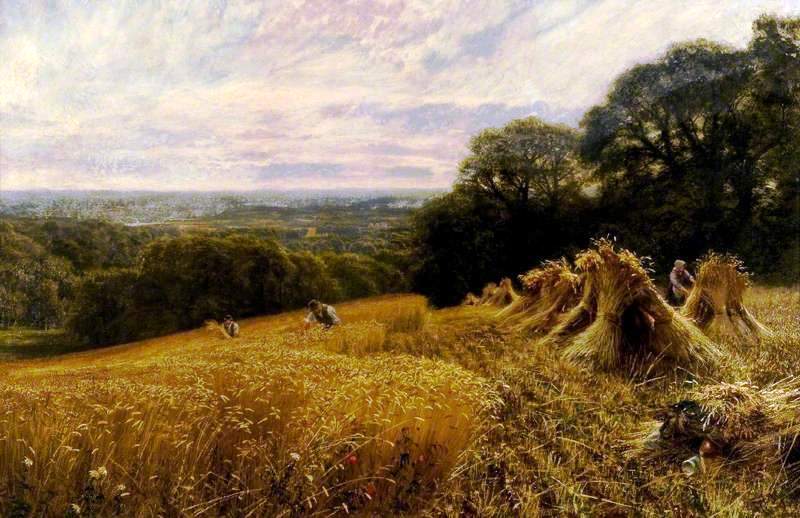
A Harvest Field by George Vicat Cole (1890) Glasgow Museums via BBC-Your Paintings http://www.bbc.co.uk/arts/yourpaintings/paintings/a-harvest-field-83551

Church and Chapel were always the warp and the weft, the yin and the yang of village life. A fellow blogger puts it thus:

Church or Chapel? It was an important question, for it defined the social circle we would be joining, our emotional support team, and ultimately our chances of salvation. The Church of England and the Methodist Chapel were the two places of worship in the village, one the establishment religion and the other dissident. The chapel stood at one end of the one street in the village, and the church was firmly at the other end. The blacksmith’s shop, with its fiery orange furnace, the heavy clink of hammer on anvil and the burning smell of sizzling horses’ hooves, stood right in the centre.

Nonconformism was a strong force in the Bourne Valley. And here Alison Deveson explains the relationship between the Primitive Methodists of St Mary Bourne and the Wesleyan Methodists of Whitchurch:

Whitchurch…began to face potential competition in the 1830s from a group of Primitive Methodist evangelists. The Primitive movement had begun in an area on the border between Staffordshire and Cheshire early in the century, as a religious revival by a number of Methodists who were dissatisfied with conventional Wesleyan Methodism…In 1830 a Primitive evangelist called Thomas Russell crossed from Berkshire to Hampshire, and, beginning at Combe and Faccombe, began to move down the Bourne Valley as far as St Mary Bourne, preaching and establishing small Primitive societies as he went.

Methodist Church

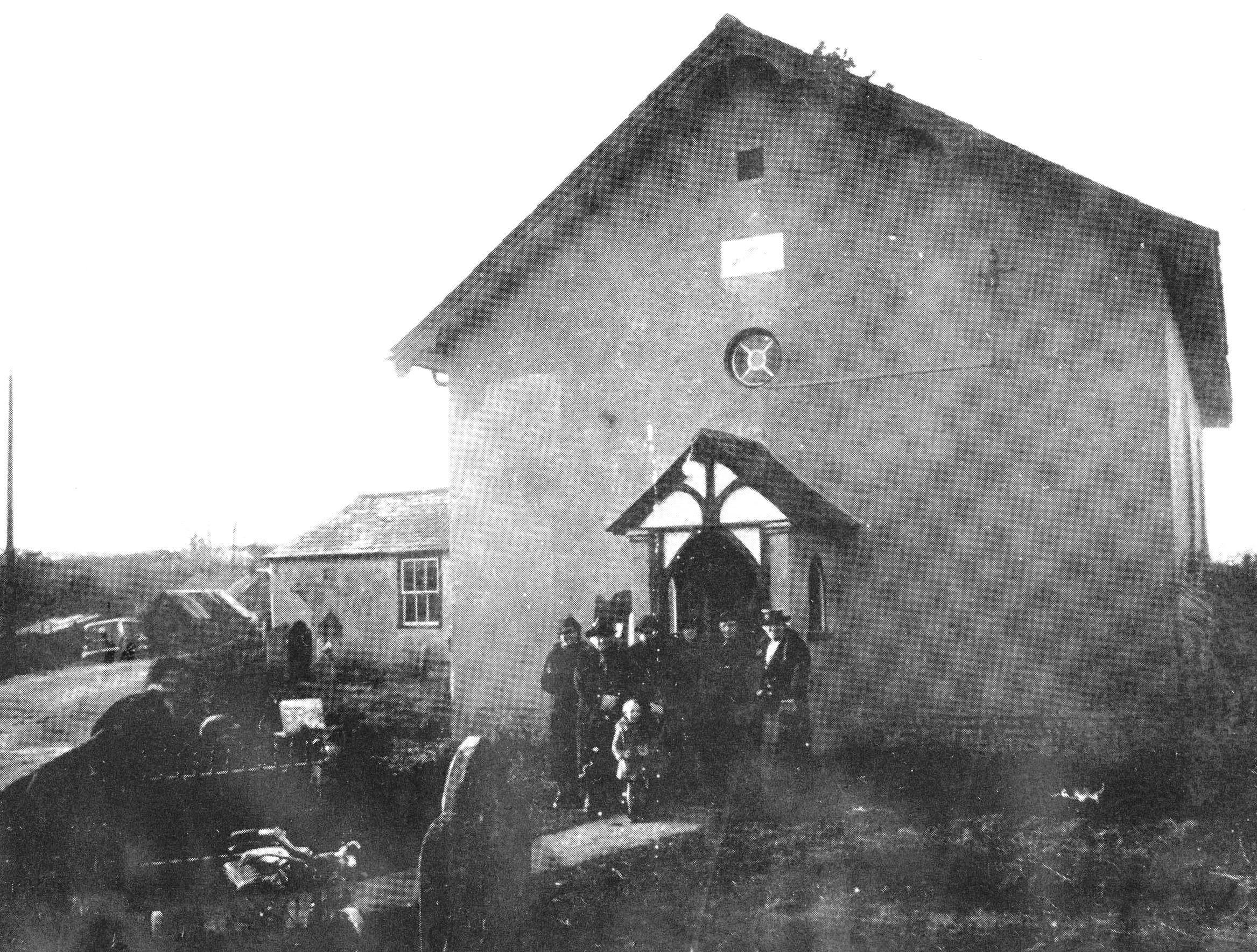
Methodist Chapel, Swampton, St Mary Bourne (see note at end of text)

Church had the advantage of establishment – they already had a building and a degree of momentum. But Chapel had its own way of winning the tug of war for hearts and minds. Mindful of the adage that the way to a [hu]man’s heart is through his or her stomachthe Primmers as they were nicknamed struck a low blow by recruiting the redoubtable Mrs Fisher to their number.

Take Harvest Festival, for example.

Andover Advertiser 25 Sep 1914

Andover Advertiser 25 Sep 1914 courtesy Julie Muirhead

The ladies are not listed alphabetically, as a diplomatic local correspondent might consider it prudent to do, but with Mrs Fisher leading her two cohorts and her daughter bringing up the rear as if to emphasise the line of command.

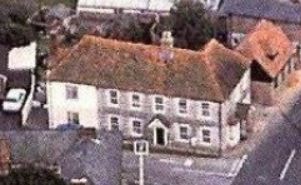
FourwaysThe reason is not hard to seek. The Fishers lived at Fourways, the house in the centre of the village next to the George Inn. The Kelly’s Trade Directory lists Henry Fisher as the proprietor of these ‘refreshment rooms’, but the 1911 census probably comes nearer the truth when it says that Mr Fisher is a wood dealer, and Mrs Fisher is ‘engaged in refreshment.’

I think it is safe to say that Mrs Fisher probably refreshed the parts that other forms of ministry found it hard to reach, and that is with nothing more alcoholic than ‘the cup that cheers’, as it says in the piece, ‘but does not inebriate’.

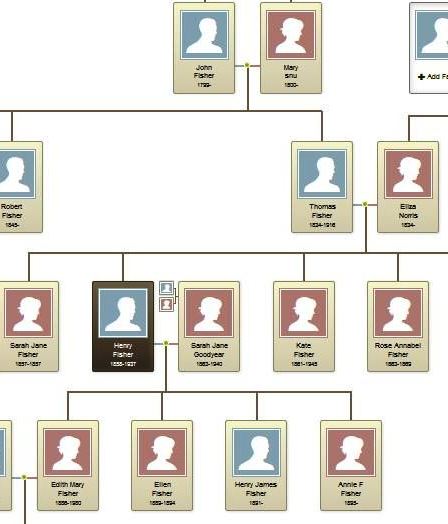
For Mrs Fisher was Sarah Jane Goodyear Fisher, and the Goodyears’ claim to the village by virtue of length of descent would have bolstered her self-confidence.

She is correctly described as Mrs H[enry] Fisher, not Mrs Sarah Fisher, so we must assume that Mrs J Cook was the wife of John Cook, a self-employed farmer, and Mrs A Goodyear may have been Mrs Alfred William Goodyear, a plate-layer on the railway (or Mrs Alfred John, Mrs Albert….).

Fisher tree


Notes

– I ‘inherited’ the photograph of the Swampton chapel amongst several others of the village and unfortunately do not know the owner. If it is yours, please contact us in the comments below so we can either acknowledge you or, if you prefer, remove the photograph.


– David Young writes about the Stoke (as opposed to the Swampton chapel above) Primitive Methodist Chapel on this page, where you can see a photograph:

Stoke (called “Stokebourne”) appears in 1834-5 in the Andover Branch of the Shefford Circuit.

Here are some figures recording the number of full society members at Stoke, extracted from the Andover Circuit account book:

1837 14; 1838 17; 1850 9; 1852 13

A site for a new chapel was acquired in 1864. A local preacher (who gave me the photograph) told me the chapel closed in 1973. It has since been demolished.

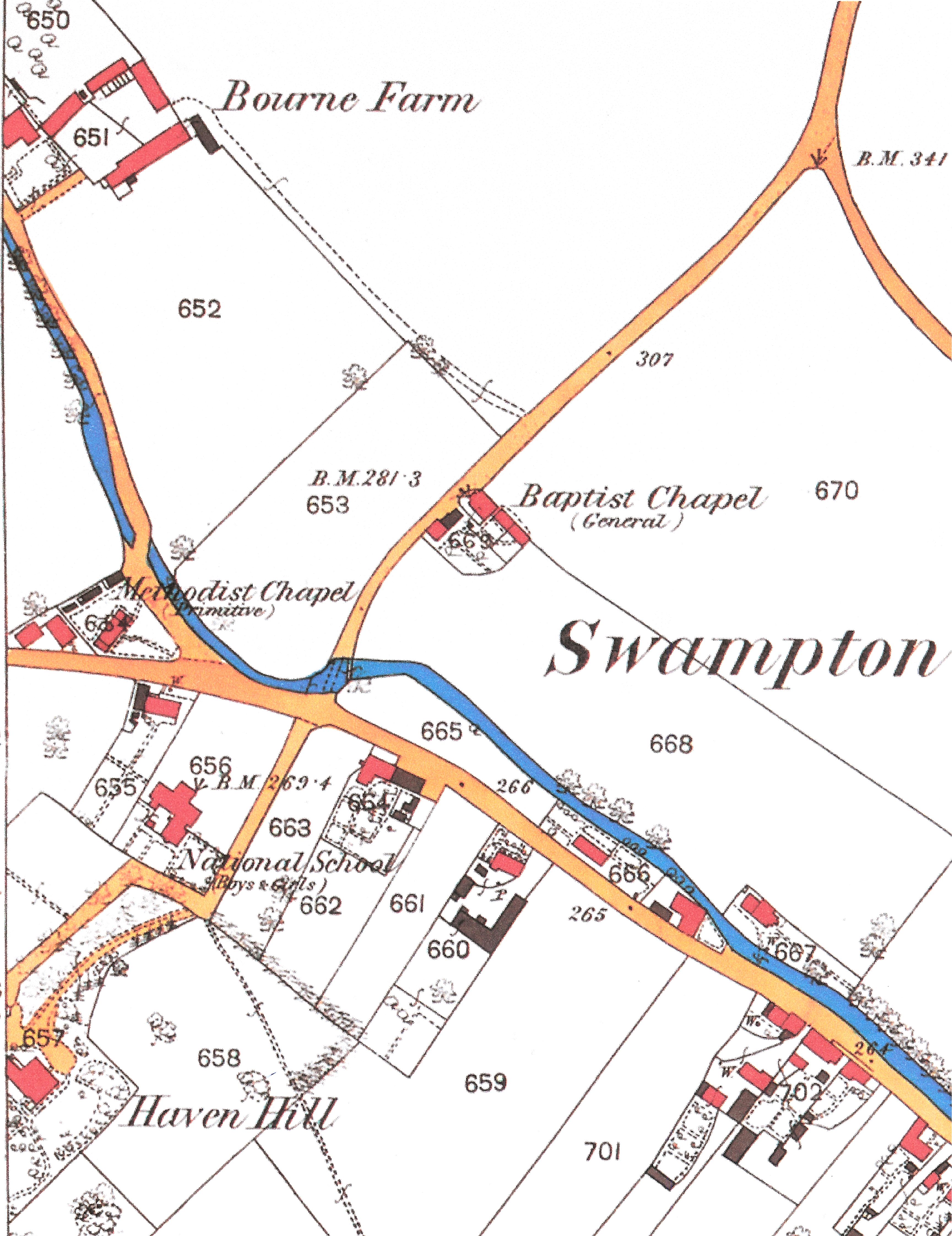
It seems from the above that the first paragraph of the Andover Advertiser article refers to the Stoke chapel, and the second paragraph refers to the one in Swampton, shown on the left hand side of this map.

001

Ordnance Survey map 1875