Led Up The Garden Path By Laurus Nobilis

‘The Laurels’ – Doctor’s House (now demolished)

This post is an anecdotal aside about the peripheral perils of local history investigation, meandering along roads not adopted, climbing up eucalyptus trees, and finding oneself up creeks without a paddle.

On this occasion, your correspondent was lured into a lengthy, if arcadian, detour by no less an adversary than the doughty Laurus Nobilis, in search of the residence of the village doctor, known from the 1901 census to be residing at ‘The Laurels’. Following, no doubt unconsciously, in the footsteps of Charles Pooter, there were apparently other villagers who also thus named their residences.

At any rate, one such was Dr William Alexander Slater Royds. Misled by the ambiguous steer of his daughter, Kathleen Innes, we had taken her comments to mean that the doctors lived in the same house as did she, after her marriage to George Innes. We thus in turn unfortunately misled our readers

InnesFinally, serendipity took pity on us and led us to browse, once again, our collection of old post cards – Eureka! Realising it might be a mistake to emulate Archimedes in running through the streets of the village naked from our morning bath, we share our rapture with you instead through the written word, deeming it less likely to end in arrest and incarceration.

Doctors house

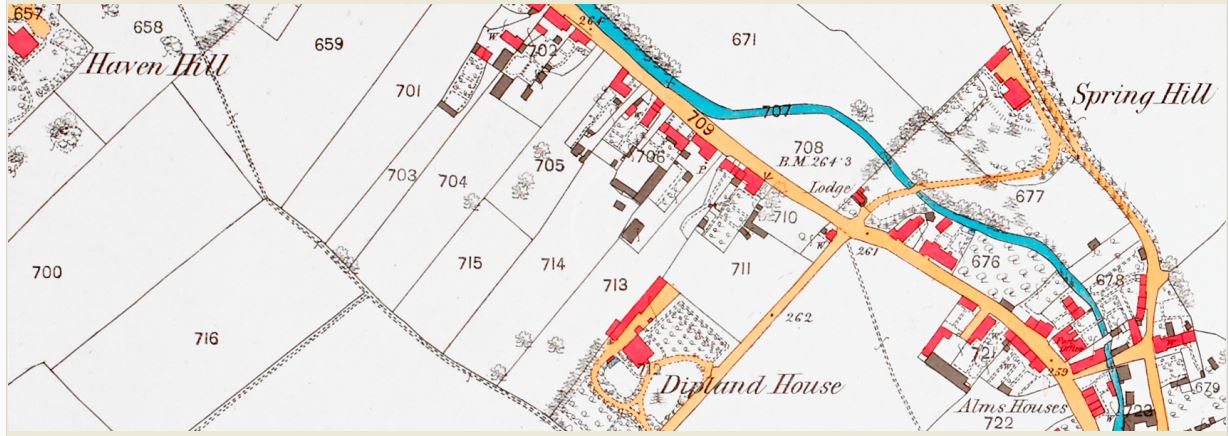
Ordnance Survey 1875

The doctor’s house is on the right hand side of the map, parallel to the road, to the left of ‘676’. It has since been demolished and replaced with two modern houses. We are told there was a small doctor’s surgery in the grounds – this seems likely to be the pink rectangle next to the winterbourne stream.

 Farewell To Dr Royds and welcome to Dr Cardwell

Dr Thomas Cardwell moved into the house some time in 1914, according to Kathleen Innes, so we shall assume that this was before Christmas. According to the directory of the General Medical Council, he qualified in 1882, and obtained the MRCS and LRCP (Edinburgh 1885).

Fred and Frank Day

Andover Advertiser

4th December 1914

FROM BELGIUM – We regret to announce that Mr and Mrs George Day
of Lower Rank, has this week received official information that their
eldest son Fred, of the 1st Hampshire Regiment has been missing since
3rd October. The information bears the usual formal notice that this
does not mean that he is killed or wounded, but might have been taken
prisoner or cut off from his regiment. Mr and Mrs Day have another son
on duty with the forces, but this one, Frank, of the Wessex A.S.C. is at
present in the home camp.

Kate And Her Able Seaman – Part One – by Win Bourne

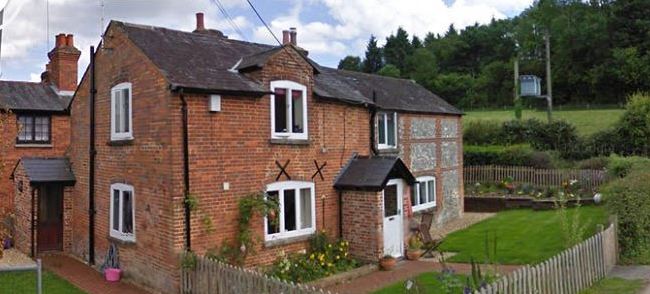
New Barn Cottages

New Barn Cottages – it would probably have been one like this

1911 census Loader

Kate Loader Turnell remembered clearly the first time she saw George Turnell. It was 1906 and she had been shopping in St Mary Bourne for her mother when she saw her older brother Freddie chatting to a strange young man. As she approached, her brother smiled and said:

‘Here’s my sister, I’m sure she will agree that we can make another place at the table tonight’.

George turned around smiling, and Kate was instantly struck by the colour of his eyes – they were almost cornflower blue. He wasn’t a tall lad, well only a couple of inches taller than her, but he gave the impression of being strong and confident. He explained that he was on leave from the Royal Navy and had heard that his father was living somewhere in the village so had travelled, unsuccessfully, to find him.Twenty year old Freddie had taken such a liking to him that he had invited him to eat that evening and probably stay overnight until he could journey back to his base, which was in Portsmouth. He felt sorry that the lad had had a wasted journey and felt sure that their parents wouldn’t mind.

The Loader family lived in New Barn Farm cottages, just out of the village, and beyond the viaduct, on the Harrow Way. Dad was a carter on the farm, as were his sons, Freddie and 14 year old Bert. Kate, who was 17 years old, helped her mother in the house and garden and did seasonal work on the farm.
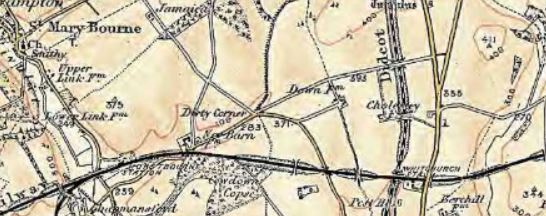
loader map

Fred was correct in assuming that his parents would be happy to include the wandering matelot into their home and later, after they had enjoyed their evening meal, George was encouraged to recount stories of his experiences in the navy.

He told them he had dreamed of being a sailor since childhood and had enlisted at fifteen years of age, his first opportunity, as a boy cadet. He had spent his first year in training in a place called Portland – an island attached to Weymouth on the Dorset coast.

At first he was on a ship docked in the harbour, called the HMS Boscawen – an elderly three decked sailing ship – where he had been taught the rudiments of seamanship. Following that he had progressed, still in Portland Harbour, to the HMS Minotaur and then finally to HMS Agincourt.

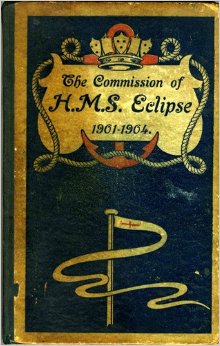
HMS EclipseOn completing his training he had been allotted his first seagoing draft on the ship the HMS Eclipse. After numerous trials, where they seemed to sail around in circles in and out of Portsmouth harbour, the commission really started. He told of his first scary voyage across the Bay of Biscay where the ship was tossed like a cork in the tumultuous seas and the crew had to hang on to ropes and rails down below and were not allowed above decks for fear of being swept overboard, many of them being violently sick. George described the change of the waters when the ship left the ocean and sailed into the warmer, calmer climes of the Mediterranean. He spoke of lying on the top deck of the ship, with a warm breeze, no land to be seen – just a myriad of stars in a midnight sky.

He told them of his first sight of the Rock of Gibraltar and how, along with some of his crew mates, he had climbed the huge rock and seen the apes up there and been surprised as they swung out over the precipice to retrieve a bun or some such. The crew members had all been warned before going ashore, to hold on to their hats and leave nothing loose for the mischievous apes to grab. This had been his first port of call on foreign soil, to eat foreign food and hear foreign language being spoken – and he had loved every minute. The HMS Eclipse had called at many ports along the Mediterranean; he remembered hearing the clanging of church bells across the water before docking in Malta. The ship travelled through the Suez Canal and beyond – all the way to China.

He talked long into the evening of other voyages and Kate and her brothers were enthralled and even more amazed when he took off his jacket, rolled up his right sleeve to reveal a picture – a tattoo of a Geisha girl. The family had seen people with tattoos before but never in such vibrant colours. The youngsters begged him for more tales, but as he had to leave early the next day to get back to his ship in Portsmouth it was time to sleep, though he promised to visit them again when he had leave.

The next time George came to the village there was no pretence about looking for his father. The Loader family welcomed him and treated him as member of their family, and he was so grateful, having known none before.

His visits were irregular, according to whether he was based on shore or was at sea. Whenever he did come back, he regaled them with more tales of his excursions across the world, occasionally bringing them small gifts that he had bought in foreign ports.

He started writing to Kate and she readily replied. On his following few stays it became apparent that, though the sea was his first love, he was becoming smitten with her – and she with him. Sometimes Kate did not see him for months and gradually their romance had blossomed, mostly by post. When he did come home they walked out regularly and became a familiar sight arm in arm in the village, attending church and visiting friends.

They had written frequently, their letters becoming more affectionate as the months went by, and when George arrived in St Mary Bourne for a short weekend, after a very long absence, Kate was overjoyed to see him. When the family had greeted him and then returned to their daily chores he suggested they went for a walk together, and as they walked George asked her to be his bride. Kate had been so happy to accept his proposal. The following day they had arranged to be married in St Peters Church on his next leave.

Before he went back to his ship after his proposal, George told her he had a surprise for her, he rolled up his left sleeve to reveal- yet another tattoo of a geisha! This time the girl had – not the coal dark almond eyes of Japanese – but round green eyes similar to Kate’s own.

When he had gone back to Portsmouth she discovered a beautiful card on the mantelpiece- once again with a picture of a geisha.

Inside it read “My darling, I may have the geishas on my arms but I will always have you in my heart, George xx”

In the following few weeks Kate had busied herself with preparing to become Mrs Turnell soon, with her family’s blessing. She remembered thinking -here she was at 21 years of age in 1910 – about to become married to her handsome blue-eyed seaman – life had looked so exciting!
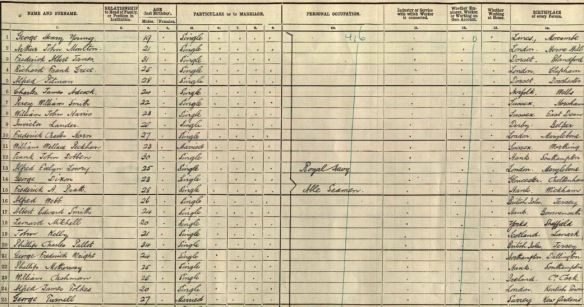
1911 census turnell


Note

There is some mystery about the identity of George Turnell. Although it says on his naval papers, and is repeated on the 1911 census, that he was born in Kew and his father’s name was also George, no trace of the birth of such a person can be found in the usual genealogical sources. There is a George Turnell son of George born in Wellingborough, Northamptonshire at about the right time which could conceivably be him but this is of course speculation. One possible explanation might be that he was illegitimate, or an orphan, which might explain why he had gone to sea at such an early age. (Also speculation!).

The tattoos, however, are absolutely real and form part of his naval record ‘Japanese girl on right arm’ and then a couple of years later ‘Japanese girl on left arm’.

Most of the cottages for New Barn Farm have been rebuilt; this is one which would have been there in the Loaders’ time, but we do not know whether this was the exact one they occupied.

Ed.


Win


Sydney Gunnell Killed in Action 23 November 1914


?????????????????????????????????????????????????????????????

Andover Advertiser 11 December 1914 courtesy of http://julz-ancestralresearch.me.uk/?p=801

Capture

Locality:
Comines-Warneton, Hainaut, Belgium
Identified Casualties:
253

Historical Information

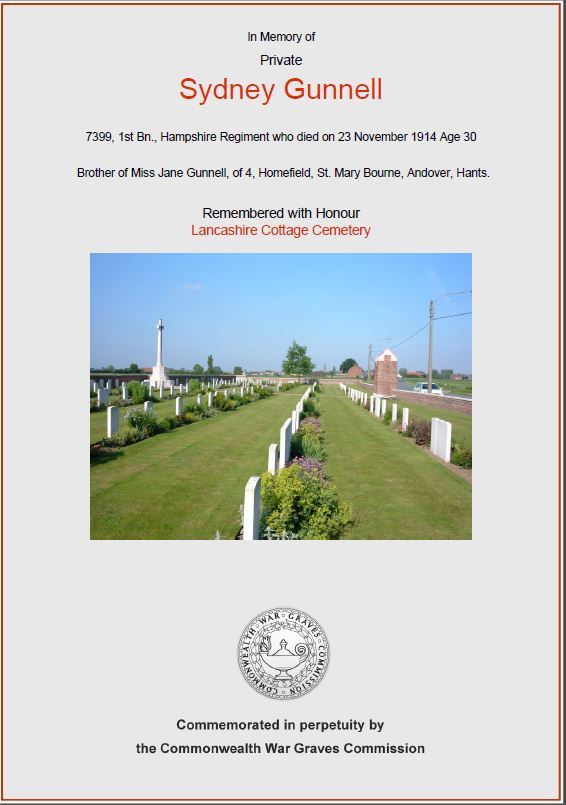
Lancashire Cottage Cemetery was begun by the 1st East Lancashire (who have 84 graves in it) and the 1st Hampshire (who have 56) in November 1914. It was used as a front line cemetery until March 1916 and occasionally later. The cemetery was in German hands from 10 April to 29 September 1918 and they made a few burials in it during that spring and summer. The cemetery was designed by Charles Holden.

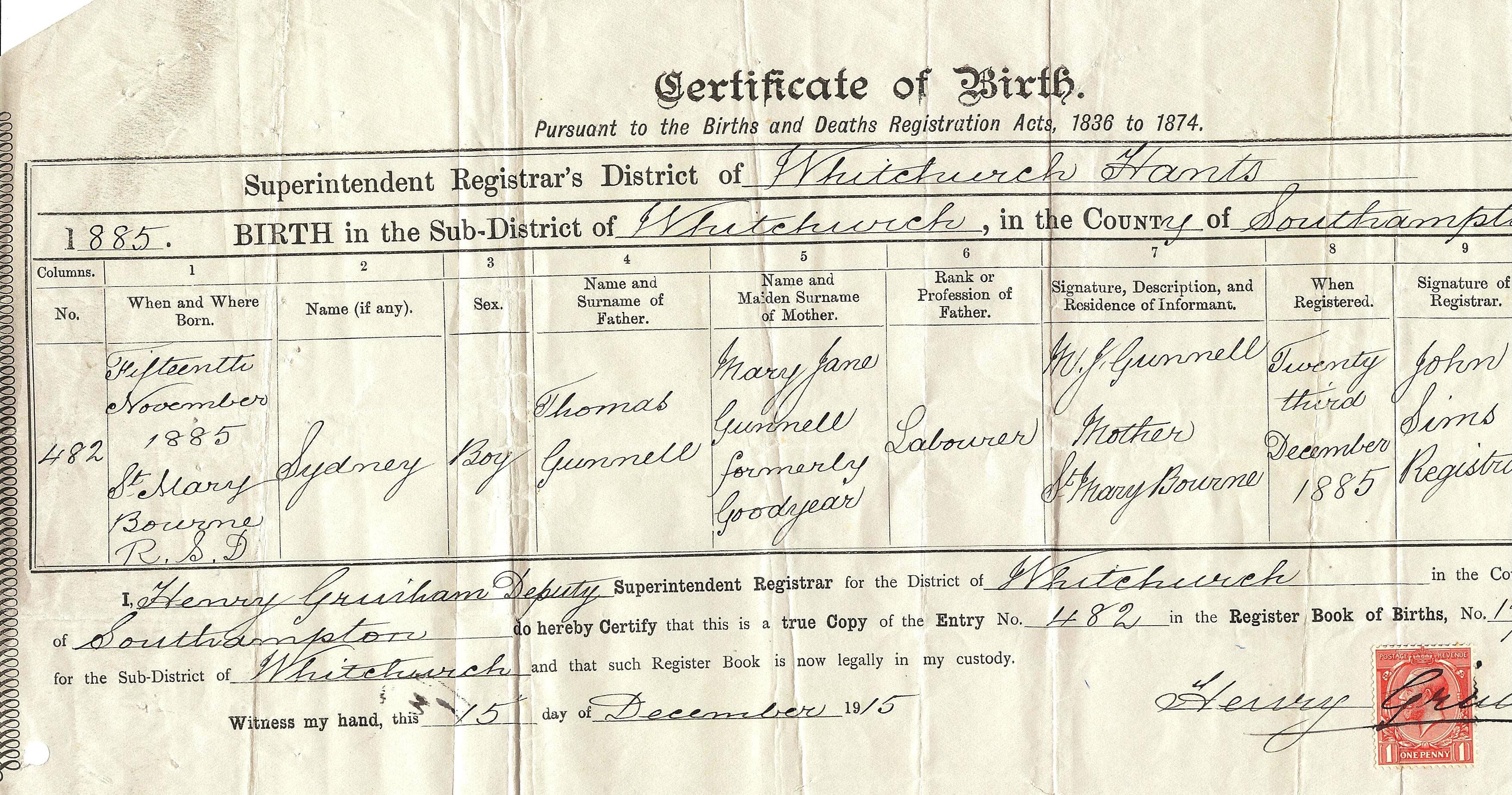
sidney gunnell birth cert 001

Original Birth certificate scanned and reproduced by permission of JN

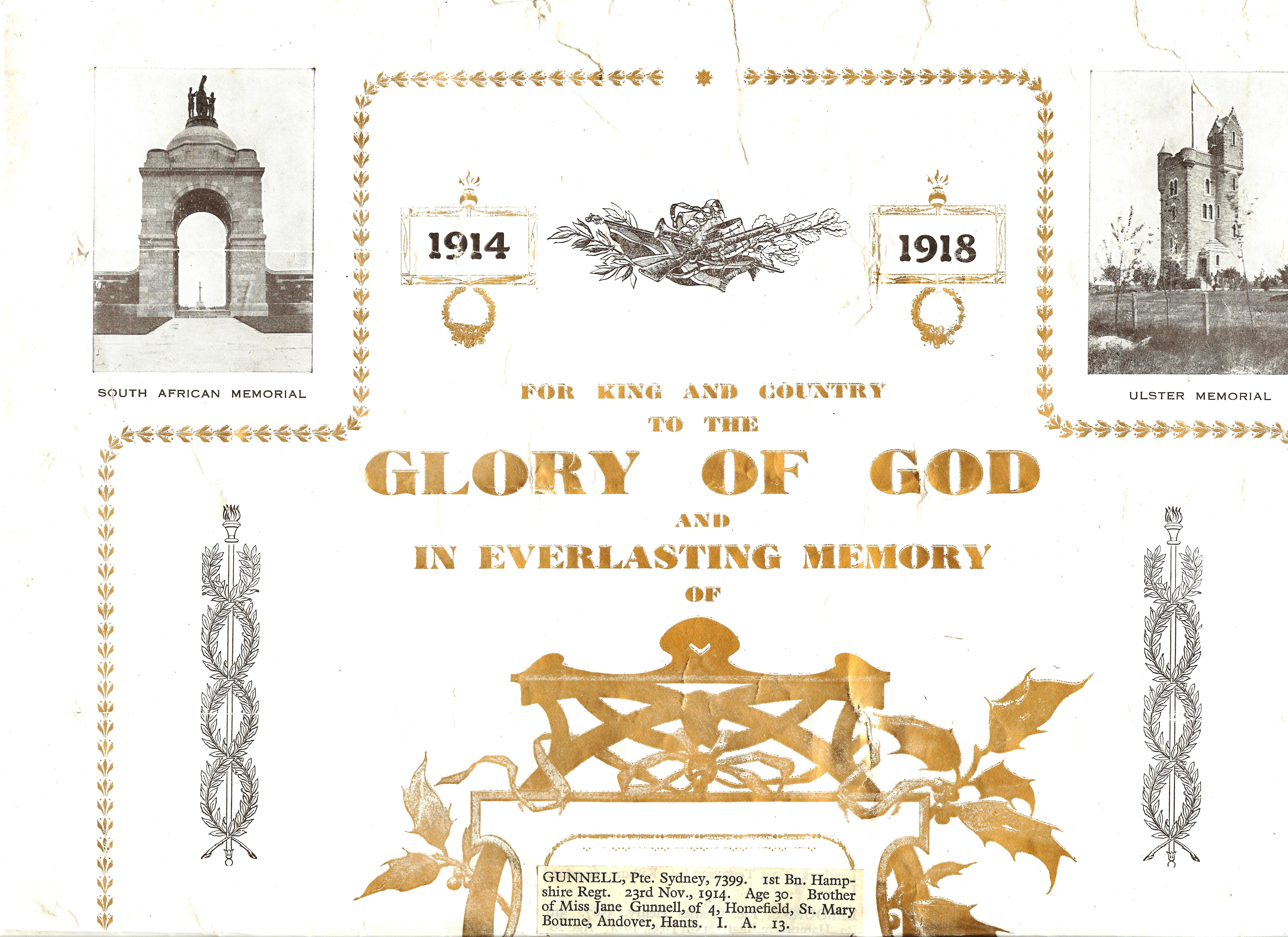
sidney gunnell in memoriam poster 2 001

Scanned and reproduced by kind permission of J N


Note

Further background on Sydney Gunnell can be found on this blog’s previous post here, and the detailed post by Julie Muirhead here.

Some Mother’s Son: George Andrew Bacon Kent

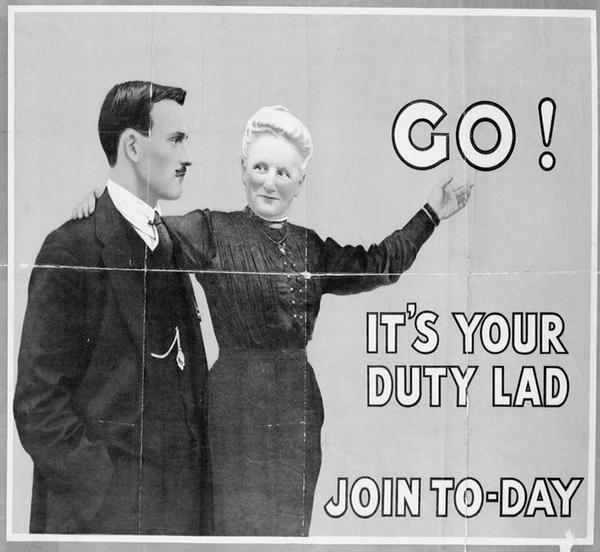
Mother or grandmother urging son to enlist

To the army he was George A. Kent. Private George A. Kent of the 2nd Battalion of the Hampshire Regiment. To be blunt, to the army he was cannon fodder.

But to Emily Bacon Kent, he was her first-born, her beloved son Andrew. The ‘George’ had been to please her father, but he had never been called anything but Andrew by his family and friends. She looked at this latest effort to get young men to sign up, by recruiting their mothers and grandmothers to shame them into it, and she felt physically sick.

She would have done no such thing, but of course she hadn’t needed to – Andrew was recorded by the Andover Advertiser as having joined the war effort by mid-October with another 60 from the village.

Kent, AndrewKent George AndrewThe 2nd Battalion The Hampshire Regiment had only eight months in India when war broke out. On August 31st it was directed to leave Mhow at once for Bombay to take over from the Sherwood Foresters. The Battalion stayed at Colaba (where they removed ammunition from a ship on fire in the dockyard) until the middle of November, when the 1/7th Hampshire relieved them. In all 21 officers, 43 sergeants, 15 drummers, and 816 rank and file boarded the Gloucester Castle on November 16th and headed for England.

Emily was desperately worried about what would happen to her son, and whether he would survive the war. The village had just had news of the first casualty, Frederick Day, and no doubt others would soon follow. Winter was fast approaching, and she was worried about his keeping warm. She didn’t know where he was – his whereabouts were apparently a matter of national security.

She tried to concentrate on the difficulties of those at the front, and not dwell on her own pain. She tried to concentrate on her husband and other two children, and remain cheerful. But it was not easy – for one thing, those at the front had bursts of danger and fear in the middle of battle interspersed with quite long periods of waiting in relative safety for the next thing to happen. But for the families sitting at home, there was no such respite, the fear was constant. It was corrosive, and, if she let it, it would paralyse her completely so that she could not undertake even the simplest domestic task.

More than ever, she was grateful for The Hurdler’s Arms, the Binley pub which she ran. Grateful because she was never alone so long as it was open, and grateful that it forced on her a routine which absorbed much of her time. She would just have to keep her head on, and concentrate on doing that to the best of her ability so that she simply didn’t have time to think about anything else.

G A B Kent family tree

Freddie The Errand Boy: by Win Bourne

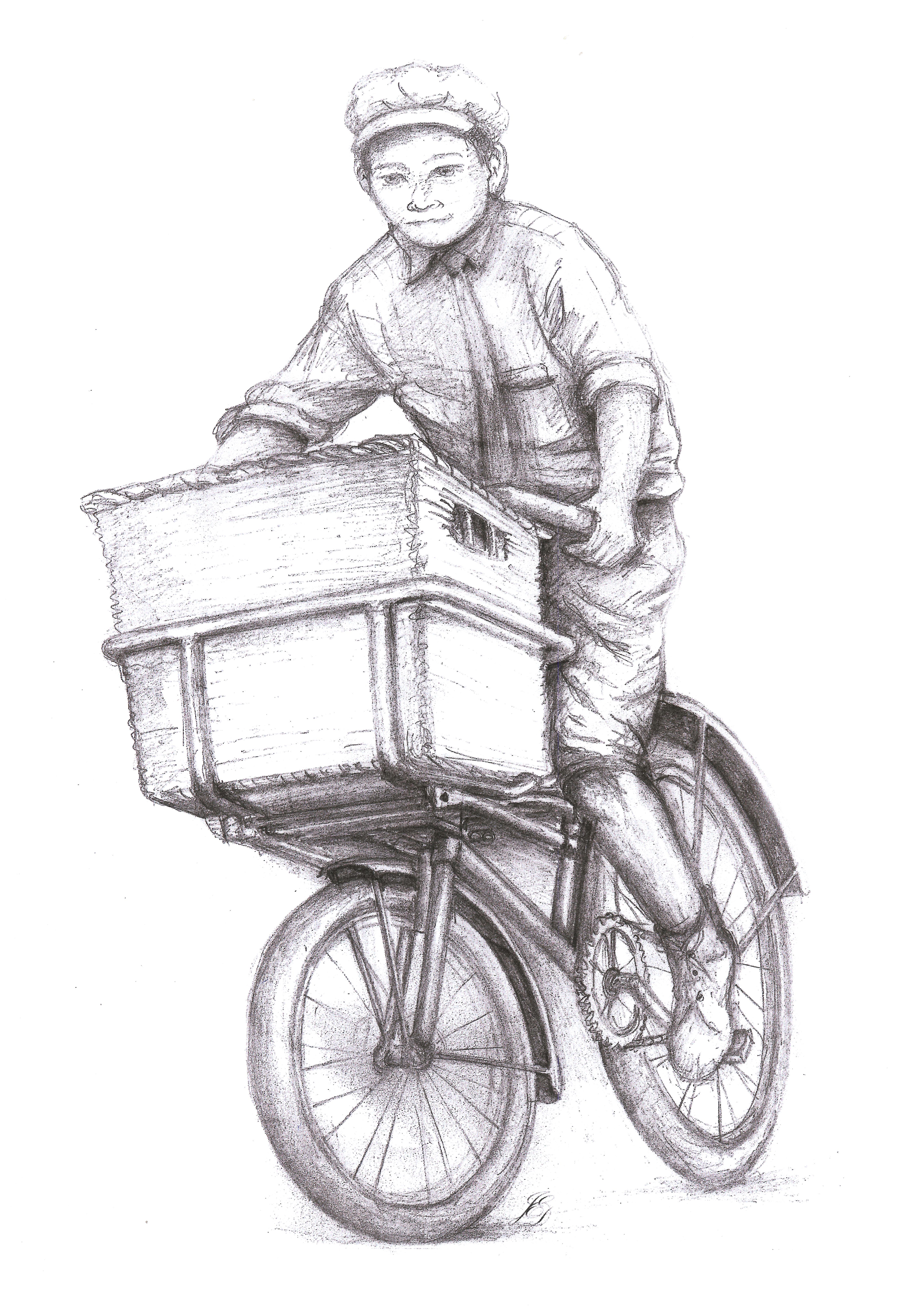
bike 001

Kindly illustrated by Jeanette Davies of St Mary Bourne


Although thirteen year old Freddie (Frederick John Randall) didn’t spend a lot of time with his older brothers, he was very proud to boast that Alfred, the eldest, had already enlisted in the Territorials and was in training to go to war, and that Albert and Ernest, who were a couple of years younger, were keen to sign up too.

Freddie knew that his Mum and Dad were worrying about Alfred joining the army and even more so if his younger brothers did too. They sincerely hoped that this war would not last long and that the boys would come home safely so that they could get back to their normal lives.

The farm labourers – including his Dad – were working extra hours in Alfred’s absence, for though the harvest might be finished, there was always plenty of work to be done on the farm. Each day more young men left the village to answer the call, so the workload for all those remaining became heavier.

Freddie – along with most boys of his age – had not attended school during the harvest. Because this was one of the busiest times in the farming calendar, everybody – women and able-bodied children – were expected to help.

Now back at school, he still had his chores to do. He worked as an errand boy at the grocer’s shop, in place of Ernest, who now worked on the farm with Dad and his brothers. Freddie delivered provisions all through the valley on the grocer’s bicycle with the huge basket at the front – to the big houses, to the vicarage, and to those customers who were unable to carry bulky items. Having been in St Mary Bourne all of his young life, he knew everybody – where they lived and now – what they ate.

Some of his school friends must have been envious of him with his lovely job and of the few coppers he earned.

As he cycled passed Mrs Medhurst’s bakery, he would take a long sniff to inhale the lovely smells emanating from the shop.

At this time of the year (early autumn) Freddie and his pals would pull their home-made trolleys up to Wakeswood and into the woods, or Baptist Hill to collect any burnable fallen branches and fir cones found in the hedgerows, to store for the winter for the fires at home.

Sometimes he would sit his sister Florrie on the trolley on the way there, and when they reached the top of the hill by the Spring Hill turning, she would get off and pick blackberries to take home for Mum to make jam, or maybe a pie for Sunday tea along with the apples from the tree in the garden. There were also hazel nuts to be collected before the squirrels found them all.

Coming back down the hill was quite a task, every branch had been carefully loaded and the bundles tied down, however the weight of it and the steepness of the road threatened to hurtle the trolley downhill without him. The boys would take it in turns to help one another to the bottom

With this task completed he and Florrie would return home to their daily jobs. They would collect the eggs from the chicken run, wash them and take them indoors and put them in the larder. Sometimes if there were plenty, Mum would put the eggs in a basket outside the back door for sale.

Freddie would chop up kindling wood, fill the log basket with dry logs and take it into the kitchen ready for the next day, while Florrie helped Mum in the kitchen.

Often as he returned to the shop, having completed his deliveries, there would be a huddle of wives and mothers outside discussing the latest news of the village – which son, brother or husband had enlisted – and wondering how the families would manage without them, not just the labour but the money they earned too.


Notes

Although we have no independent corroboration of Frederick doing his brother’s grocery run, it seems highly likely that this is in fact what happened. Their father worked on a farm according to the 1911 census and the harvest meant extra money for all who could help. With so many having left for the front, extra hands would have welcome, and (relatively) well paid. But Ernest would have been older and stronger than Frederick, hence their all moving up a step. Ed.

Win

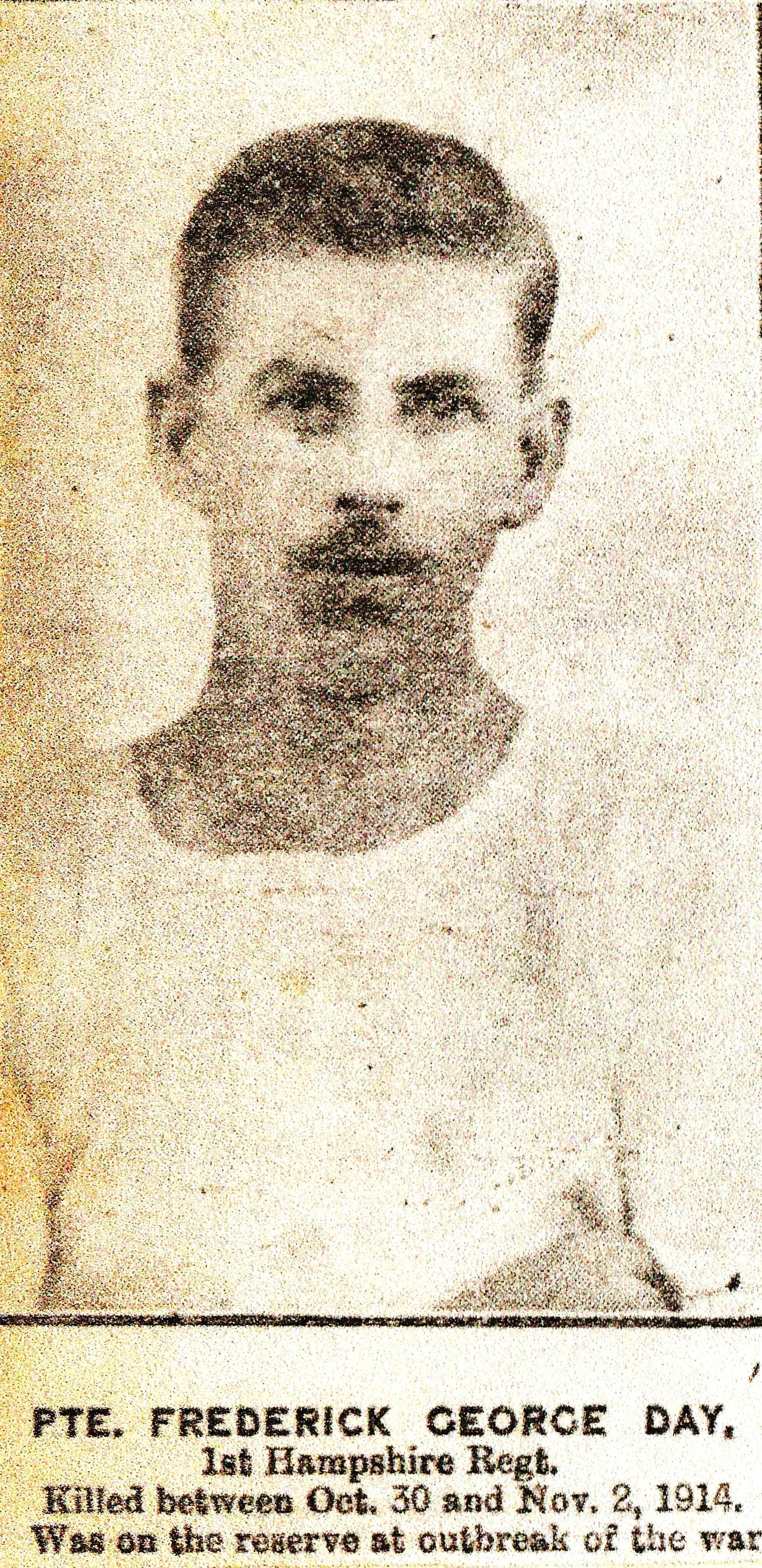
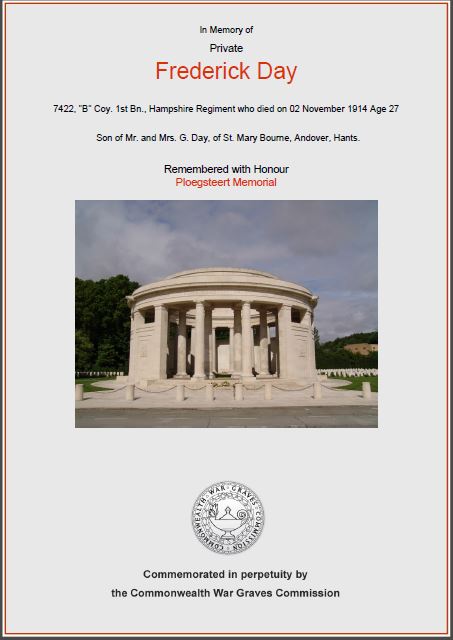
Frederick George Day Killed in Action 2 November 1914

001 (5) - Copy

leanne bell war memorial pto in booklet

Village War Memorial courtesy of Leanne Bell

DAY_FREDERICKFrederick George Day is officially recorded as having been killed on this date, but his family (and the village) were not informed until December. Details will be covered in a later post.

Charles James Knight and William John House

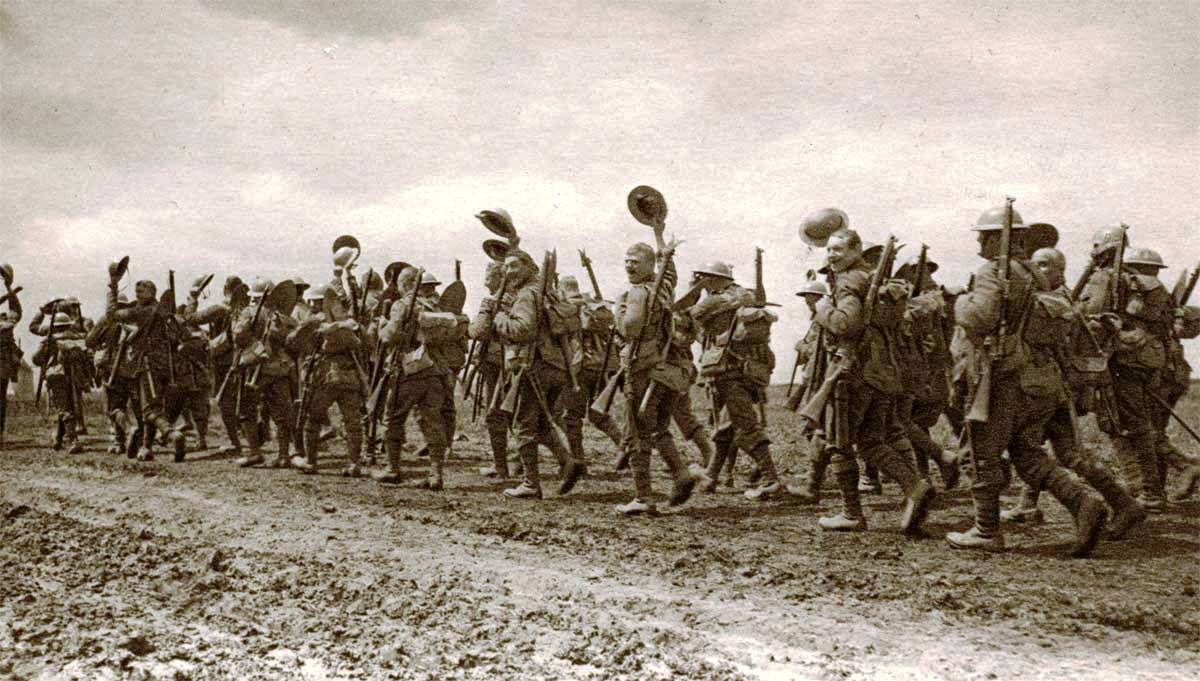
Cheering_wiltshires_1918_005

Cheering Wiltshires in 1918 via Commons wikimedia

Andover Advertiser 30th October 1914

FOR KING AND COUNTRY – After passing the cross roads at
Chapmansford, the first block of two cottages on the road to Hurstbourne
Priors has peculiar interest to the passer by. Each has sent its manhood to
fight for King and country. From the first cottage Charles James Knight has
gone with the 1st Wiltshire Regiment, and has not been heard of for a
fortnight.

In the next cottage live the wife and two children of William John
House, 1st Wiltshire Regiment, who was wounded on 9th September in the
battle of Chesny, taken prisoner, and now lies in the Royal Reserve Hospital
in Potsdam, about 18 miles from Berlin.

Mr House went through the biggest part of the Boer War, and helped to capture Piet Cronje, the Transvaal General, who, after a skilful and determined resistance to Lord Methuen at Magersfontein, surrendered with 4000 of his army to Lord Roberts on the
Modder river on 27th February 1909. Mr House obtained the South African
medal, which his wife shows with pride.

On the declaration of war last August Mr House went to Devizes, the depot of the 1st Wiltshires, saying that it was his duty to go, although it was a sore wrench to leave his wife and children. He went with his regiment from Tidworth, his wife received a note from him saying that he had landed safely, and a few days afterwards he appears to
have been wounded in the arm at the battle of Chesny.

Mrs House received the intimation as to her husband’s whereabouts from the American Embassy not having heard from her husband after he intimated his safe landing,
although she has written to him each week. Mr House has two brothers who
are with the navy in the North Sea, and his youngest brother (19 years of
age) is in the Territorials.

The First Wiltshires

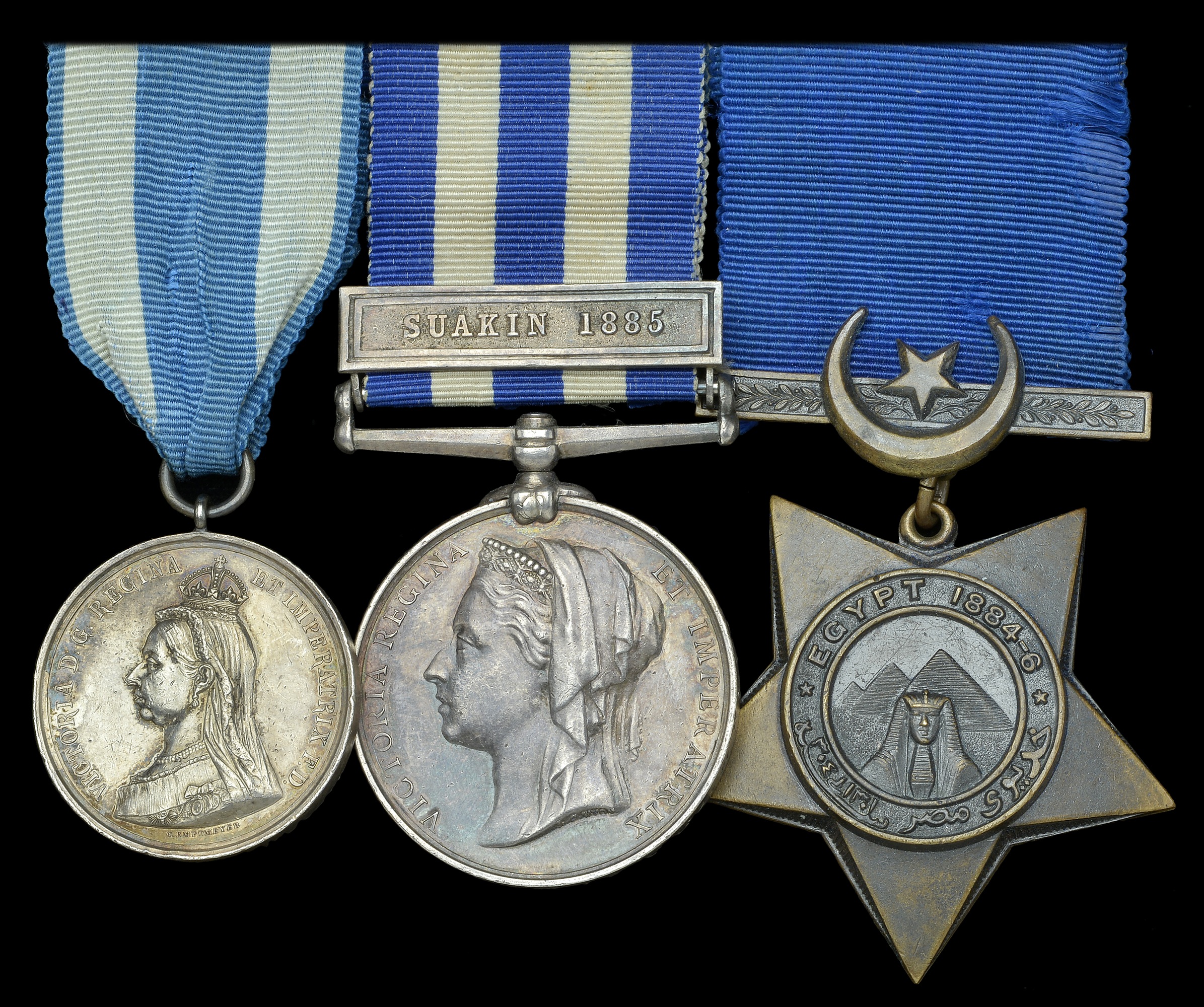
At the start of World War I, the Wiltshire Regiment, like most of the rest of the British Army, consisted of two regular battalions (1st and 2nd), a reserve battalion (3rd), and a Territorial Force battalion. Eventually, the Wiltshire Regiment expanded to ten battalions, seven of which served overseas.[30] These included three additional Territorial Force battalions (1/4th, 2/4th, and 3/4th Battalions) as well as four service battalions (5th, 6th, 7th, and 8th battalions) formed for the Kitchener Army formations.[30]

Regular Army battalions

Upon mobilization and declaration of war, the 1st Wilts deployed to France as part of the 3rd Infantry Division‘s 7th Brigade, landing in France on 14 August 1914. The 1st Wilts remained with the 3rd Division until the 7th Brigade was transferred to the 25th Division on 18 October 1915. The 1st Wilts served with the 25th Division until was transferred on 21 June 1918.[31] On 21 June 1918, the 1st Wilts joined the 110th Brigade, part of the 21st Division, with which it served for the rest of the war.[30]

Lt Col Henry Longfellow Cooper: A Hard Man To Resist?

Emma Elizabeth Folson Cooper was not just a daughter of the regiment, she was now a sister, wife and mother of the regiment as well, and she had had no say in any of it!

Captain Henry Folson medals from several sale catalogues 2014

Her father, Henry Folson, had been Quartermaster for most of his career, but in 1895 had been made an honorary Captain of the Coldstream Guards just before his retirement.

Her one brother, William, was a Battery Sergeant-Major in the Royal Field Artillery (and would be promoted to Lieutenant before the war was over).

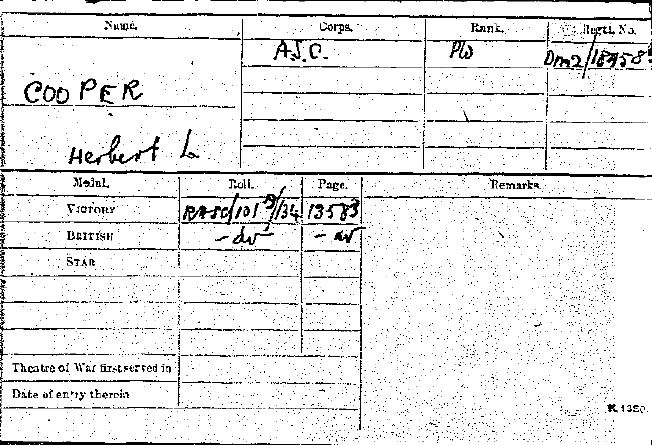
Her only son, Herbert Longfellow Cooper, had been nabbed as soon as he was old enough for the ASC by the biggest recruiter after Lord Kitchener, her husband. *

The eponymous Lt Col Henry Longfellow Cooper was running the Wessex Division of the Royal Army Service Corps. Before the war, he had been a granite merchant and, much as she loved him and appreciated his charm, he was a man of granite in more ways than one: he was someone no one could say ‘no’ to.

She had lost track of how many young men ‘the Colonel’ had managed to recruit into the ASC, not just since war broke out but in earlier years as part of the Territorials. He was a sort of Pied Piper of Hamelin, luring what were little more than children with his siren songs to go off to fight . Not that she had ever dared mention the parallel to him…

Sachsenspiegel-Ostsiedlung

Sachsenspiegel-OstsiedlungPublic Domain Eike von Repgow – Heidelberger Sachsenspiegel, Cod. Pal. germ. 164


They had been living since they came to St Mary Bourne more than a decade ago at Wakes Wood, a large house at the north-east end of the village. Now that Herbert and his sister had left home, she and Henry were rattling around in it and she had finally persuaded him that they would be much better off at the charming house called Butler’s next door. There just remained the question of finding a buyer for Wakes Wood in the current market (not many people were looking for what was virtually a mansion in 1914).

Wakeswood

Longfellow Cooper


Notes

*herbert l cooper Identification of Herbert, the Coopers’ son is not absolute, but no other likely candidates have been found, and it seems entirely in keeping with his father’s reputation that he should have joined the RASC.

Florrie And The Country Crafts: by Win Bourne

Little_Girl_Knitting_-_Albert_Anker

Little Girl Knitting by Albert Anker via wikimedia.org

All through September most households in the valley had been busy harvesting their own garden produce as it ripened. Wives had been busy bottling fruit, making jam and pickling vegetables. Larders were replete with Kilner jars labelled and stored, ready to supplement the winter diet. The husbands had pulled up the onions, wrapping them in skeins and hanging them out to dry on hooks on the wall. They had prepared sloes and damsons to start blooping away in the shed in large buckets ready to transfer to demijohns and converting hopefully, into wine. If they were lucky they might have obtained some barley and had a barrel of beer brewing.

Now, in October, the thoughts turned to winter and the next season’s events.

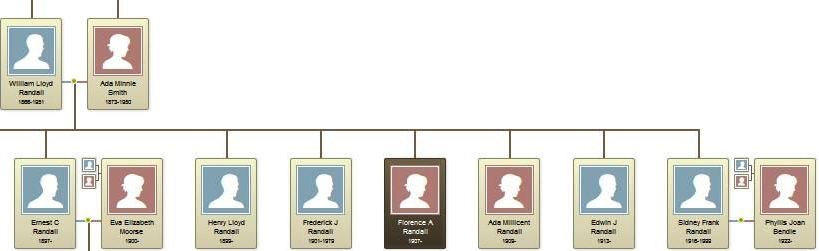
This was going to be the best Christmas ever. Mum had taught seven-year old Florrie Randall how to knit and, as she sat outside in the late afternoon sun next to her, she was deciding which colour wool she would choose next.  Mum, and some of her neighbours – perhaps Mrs Benham and Mrs Pearce – would gather their chairs together outside in their yards to catch the last of the sun of a late afternoon to knit and chatter, the evening meals already prepared for the men coming home from the farms and the stables later.

Early preparation was crucial for gifts to be complete for the Christmas morning. Ladies were knitting, crocheting and sewing as fast as their nimble fingers could work. Florrie concentrated hard on her next stitch – in with the needle, round the needle with the wool and pull the needle back and off with the wool- done it- another stitch complete. This would only take a few weeks at this pace she thought. Mum had told her that there was a little bit of love in every stitch, and she did love her sister.
Mum had allowed her to rummage through her wool bag for scraps of left-over yarn and taught her how to knit a square. Florrie had seven squares of various hues already in her collection and she would need twenty before she could reach the next stage of her present for her little sister Ada, who was two years younger. She was going to sew the squares together to make a little blanket for a dolly, which Dad had already been busy making in his shed, along with a crib. Mum was knitting tiny garments to fit the dolly.
Oh! This was going to be Ada’s very best Christmas, and if her brother Alfred was home from the Army and this silly war was finished it would be the very best Christmas for the whole family.

After the evening meal Mother, Ada Randall, was busy on yet another piece of handiwork. She had acquired a hessian sack from Eli Brown, the carrier. Goodness knows what it had originally contained, not coal or anything wet or smelly, that’s for sure. She had soaked it in soda then washed it in the copper and now, as it hung out to dry, it smelled lovely.

Ada had spent many evenings painstakingly cutting strips of material about an inch wide and four inches long, while the light held. She had searched through her rag bag (everybody had a rag bag – a collection of worn out shirts, their buttons removed and saved, blanket pieces, sheets, skirts and even trousers – any length of material too good to throw away, no matter how big or small) and selected the strongest and thickest pieces. Once the onerous task of cutting of hundreds of rectangles was done, she would then begin making a rag rug – for that was the goal. Ada’s first job was to hem all around the edge of the hessian to stop it from fraying, then, with her rug hook, she would pull each strip of cloth through the weave of the backing, line after line until the rug was complete, the more strips she pulled through the tighter the rug became, making it firmer as she went.

She knew just where the rug would be put, underneath that draughty back door where the wind whistled through in cold evenings. She had already made several rugs in a myriad of colours, which were a comfort to everybody in their bedrooms as they first put their foot on the floor in the morning, that lovely soft surface instead of the cold stone floor. The rugs didn’t match, they were never meant to.
This creation was not any particular person’s Christmas present, but with that horrid draught from under the door blocked, everybody would have a cosier winter.


 Notes

A reminder of Florrie Randall’s immediate family:

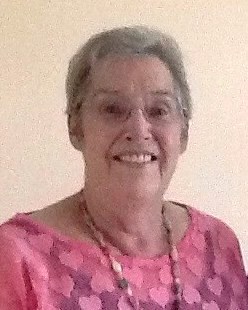
florrieWin