Unknown's avatar

About layanglicana

Author of books on Calcutta, Delhi and Dar es Salaam, I am now blogging as a lay person about the Church of England and the Anglican Communion. I am also blogging about the effects of World War One on the village of St Mary Bourne, Hampshire.

Fears of the Ladies’ Committee are Realised

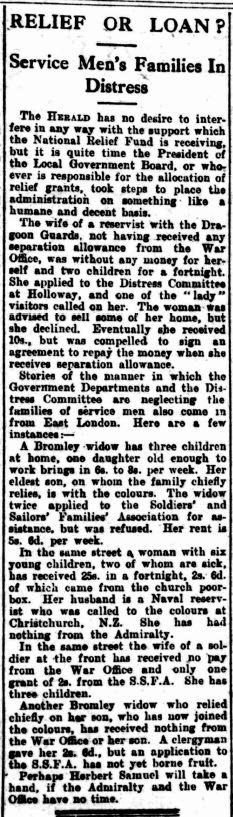
DH 16 Sep 1914DH 16 SepFrances Selfe had her worst fears confirmed by this morning’s newspapers.

It was proving a national disgrace – fathers and sons were being sent off to the war with no proper provision for the children, wives and mothers (sometimes widowed) who depended on them for their daily crust of bread.

No farmer ever admitted he was rich, but several of the families whose members had gone to war were not, she presumed suffering financially. Of the list that had been put up in the church porch, surely the Neales and the Pennys were not in any want.

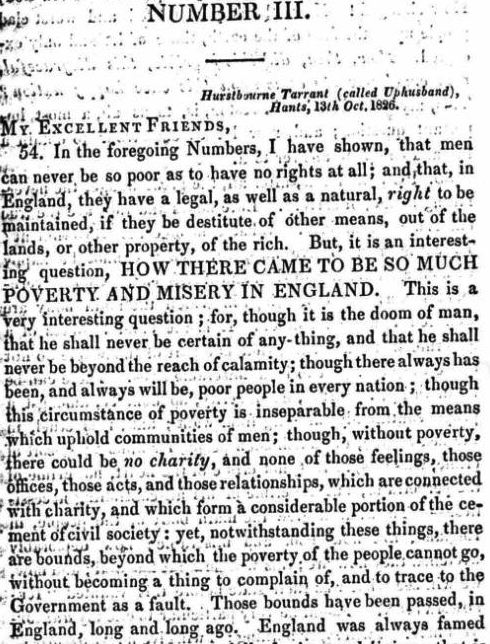
But those who were employed to work on the land in the Bourne Valley had for many years been amongst the poorest of England’s agricultural workers. That firebrand, William Cobbett, had devoted a whole issue of ‘The Register’ * to the plight of the poor in the neighbouring village of Hurstbourne Tarrant and now, nearly ninety years later, it must be admitted that their situation had not greatly improved.

Something must be done. But what?

She and her committee could – and would – go through the list to see who was likely to be in want. But it was no easy matter simply to hand out coins or food: the people here were as proud as anywhere else and would hate to think that their circumstances were being discussed. Perhaps it would be possible to pair each family with one of her committee who already knew them well and could tactfully ascertain the position without giving offence.


*’Part of the Whole of the Expenditure on the Poor’: William Cobbett’s ‘The Register’ of 1826. Extract from first page of article:

Cobbett

Millinery Is War By Other Means

Capture2dm 14 sep 1914

As Clausewitz almost said, War is Millinery by Other Means. Or do I mean Millinery is War by Other Means?

Eleanor Louisa Black-Hawkins née Young was rather pleased with her little joke, only slightly marred by the fact that she doubted whether anyone else in St Mary Bourne had ever heard of Clausewitz. This was one of the reasons she liked to divide her time between Hampshire and her Kensington pied à terre. She knew that this did not endear her to her St Mary Bourne friends, and particularly irritated her rather self-satisfied sister-in-law, Frances Hawkins Selfe, who had profited from one of her absences in the metropolis to set up a ‘ladies committee’ to be part of the war effort, thus establishing herself as ‘queen’ of the village, at least for the duration of the war.

It was really insufferable.

But Eleanor knew what to do. ‘Box clever!’ as she had constantly been urged as a child by her somewhat manipulative father – any counter-offensive needed to be on different turf, it would never do to engage in single combat on Frances’s own territory. And of course it was essential that such a counter-offensive be plausibly deniable.

The answer leapt off the page at Eleanor as she opened her morning newspaper. Millinery, very expensive millinery, was the key to solving her dilemma.

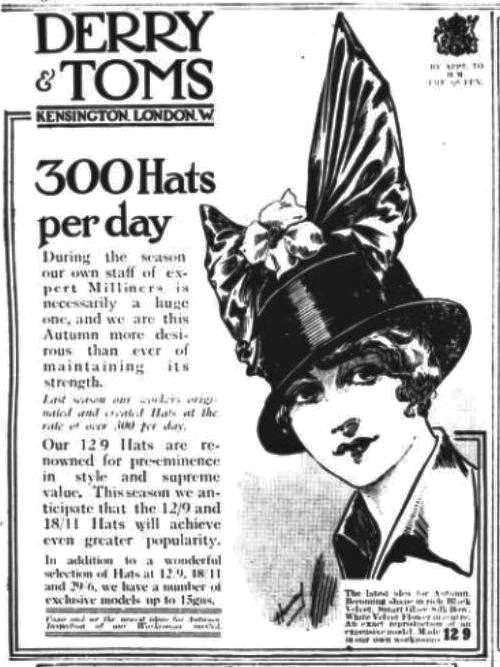
As the advertisement cleverly hinted, it was her civic duty, particularly in a time of war,  to keep the ladies of Derry and Toms millinery department gainfully employed. Why, without her and her friends, the sales assistants would be out on the street and might even starve. Or worse!

There was a meeting of the ladies committee next week, which Eleanor would graciously attend. Before that, she would nip up to London to dear Derry and Toms, just round the corner from Oakwood Court, and choose a hat. A hat that made a statement. In fact the hat in the illustration was just the thing. A hat that brooked no gainsaying. A hat that would carry all before it.

As the meeting was in Frances’ own house, she would not be wearing a hat. But it would be entirely appropriate for Eleanor as a visitor to wear one. And not one of your 12/9 hats, either. She rather thought that the one in the illustration would be the one selling for fifteen guineas. What fun – she hugged herself in anticipatory glee. And to think she had been in rather low spirits when she had got up that morning.


War is not a mere act of policy but a true political instrument, a continuation of political activity by other means.”

CLAUSEWITZ, ON WAR
pp 75-89  (From the Michael Howard/Peter Paret translation, Princeton University Press, 1976/84, based on the original in German, Vom Kriege, Dummlers Verlag, Berlin, 1832.)

The Second Wave Of Reservists

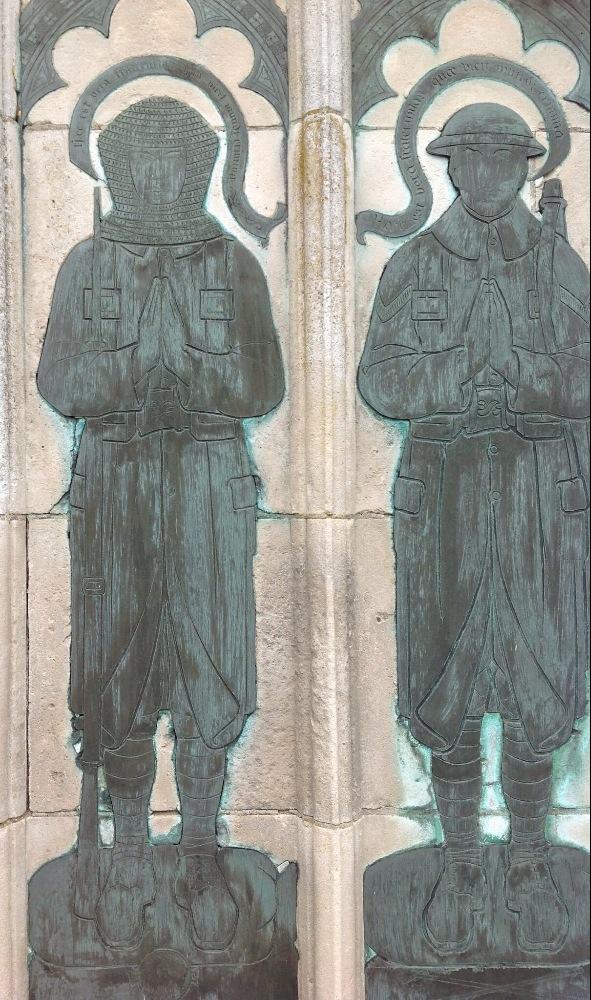
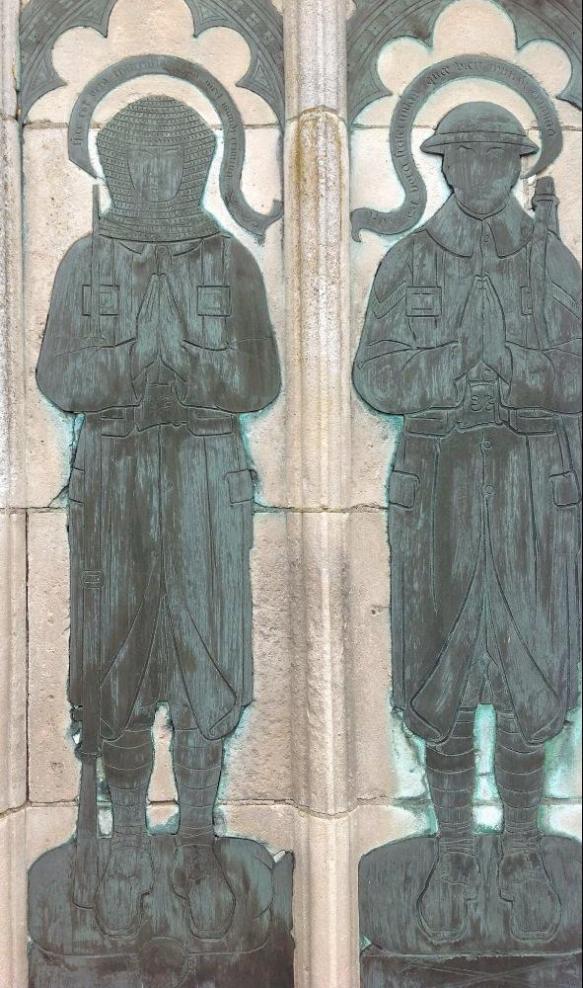
Sledmere Cross Memorial with WW1 Soldiers as Crusaders

Sledmere Cross Memorial with WW1 Soldiers as Crusaders

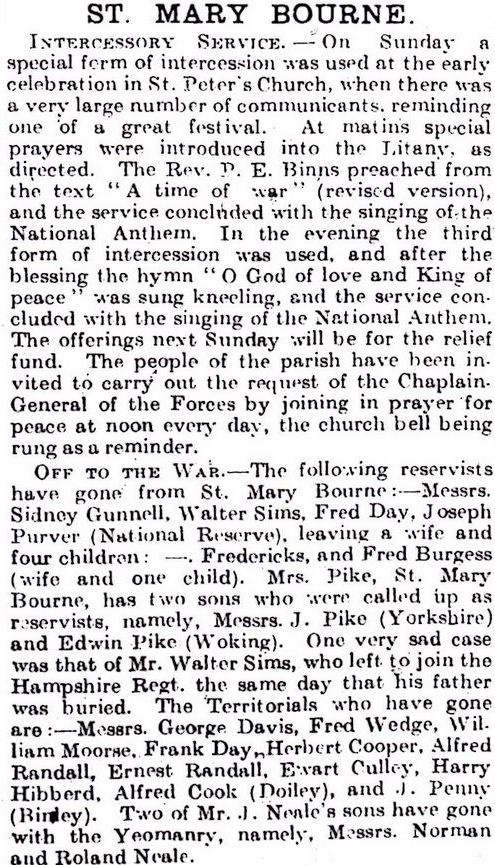
The number of those going to the front gathers pace every day. Apart from those we have written about already, we see from the article below that there are several more Reservists and Territorials who have joined up, as well as two from the Yeomanry, leaving resultant gaps in the lives of their families and friends.

Fred Burgess (‘E. Burgess’ on Roll of Honour)

{No trace of a Burgess family in the censuses or trade directories.}

Alfred Cook (lower Doiley)

Driver Army Service Corps 246 Company, serving under Lt Col H L Cooper Territorial  who went to war before 14 Aug 1914 (Andover Advertiser 14 Aug 1914)

Known from the Andover Advertiser to be from ‘Doiley’; confirmed from 1911 census to be an under-carter born in Market Lavington, living with his parents Leonard and Matilda (also from Wiltshire) at Lower Doiley, Hurstbourne Tarrant. No obvious SMB connection.

Herbert Cooper

Presumably the ‘H.Cooper’ of the Roll of Honour. Not on census or in trade directories. 235 possibilities in the National Archives.

The Revd Ewart Culley

Driver T4/056532 Army Service Corps 246 Company, serving under Lt Col H L Cooper. He was the grandson of George Culley (1832-1875) who came to farm in St Mary Bourne some time in the 1850s, and the brother of George and Wyndham who continued the farming business. Ewart himself became a Methodist minister and was sent to the Americas.

George Davis

Born about 1882, the son of Charles and Emily. On his mother’s side, he was descended from Thomas Kercher, with a connection to St Mary Bourne going back to the early 1700s. He was a driver with the Army Service Corps who had enlisted in 1908.

Now the subject of this post.

{Edward}Frank Day

b1897   son of Mr and Mrs George Day of Lower Rank (Andover Advertiser 4 Dec 1914)
Wessex Army Service Corps (number not known at present)

Fred Day

Frederick Day was the subject of this post.

Sidney Gunnell

Sidney Gunnell was the subject of this post

Harry Hibberd

Henry Hibberd was a sergeant in the Army Service Corps 246 Company, serving under Lt Col H L Cooper. Born in 1882,  he was one of three sons of Hector and Clara.

William Moorse

Born in 1886, one of seven children of William and Esther, William was attested by Lt Col H L Cooper in 1908 as he joined the Territorials.

Norman Neale

Born in 1890, the son of James John and Helena, Norman signed up for the Hampshire Yeomanry, but later transferred first to the Hampshire Regiment and then the Royal Engineers. The Neale family were the subject of this post.

Roland Neale

Born in 1894, the son of James John and Helena, it has not yet proved possible to establish in which unit he served, but in view of the Andover Advertiser article, the likelihood is that he signed up to the Hampshire Yeomanry with his brother (there was also a Berkshire Yeomanry etc). The Neale family were the subject of this post.

J Penny (Binley)

Presumably John Penny born 1893, son of John Penny, both carters from Wiltshire on a Binley farm. Corporal Army Service Corps 246 Company, serving under Lt Col H L Cooper.

Edwin Pike

Edwin Pike was the subject of this post.

James Pike

James Pike was the subject of this post.

Joseph Purver

Joseph Purver was the subject of this post.

Alfred Randall

Driver Alfred William Randall went on active service in 246 Company Army Service Corps, serving under Lieut. Col. H. L. Cooper, commanding 29th Divisional Train.

The Randalls come from an interesting Hampshire family with long connections to the Bourne Valley, and will be the subject of an imminent post.

Ernest Randall

Trumpeter Ernest Charles Randall went on active service in 246 Company Army Service Corps, serving under Lieut. Col. H. L. Cooper, commanding 29th Divisional Train.

The Randalls come from an interesting Hampshire family with long connections to the Bourne Valley, and will be the subject of an imminent post.

Walter Sims

Walter Sims was the subject of this post.

Fred Wedge

Frederick Wedge was one of many children of Frederick Wedge and Elizabeth née Goodyear, with a long local ancestry. He will also be the subject of an imminent post.

Capture

Andover Advertiser, 14 August 1914


Notes

I am indebted to Julie Muirhead for her discovery of the Andover Advertiser article.

The Sellwoods Set An Example

Lillian May Sellwood had just had her tenth birthday and was entering the second decade of her existence. With this second decade she knew would come adulthood and adult responsibilities, and on the morning of 10th September she decided that the time had come for her to shoulder these responsibilities.

Since war was declared just over a month ago, her three eldest brothers had all set off for war. The family were not exactly left to rattle around in their house in Gangbridge Road, there were still eight of them living there even after the boys had gone. But Lillian missed Frank, William and Jesse greatly, and of course the whole family were worried about them and what might happen. She and her sister had enjoyed games of Cowboys and Indians with her six brothers, and it made her feel rather uncomfortable that their make-believe fighting had now been made all too real.

Thomas and Jesse both worked on neighbouring farms but William helped Mrs Medhurst in her bakery. Lillian liked Mrs Medhurst, who sometimes tipped her a currant bun if she was in a good mood. Normally she would be stuck at school * for another two years, but now there was a war on normal rules couldn’t apply, surely? She would ask Mrs M if she could take over William’s job. The two boys, Stanley and Reg, could do Thomas’s and Frank’s work on the farms, and Marjorie could stay at home to help their mother look after the two little ones, Percy and Frederick, and do the household chores.

Doing the household chores was definitely not something Lillian wanted to do any more of than she already did, and she thought her plan would work brilliantly. The question was, should she ask Mrs Medhurst first and get her to ask her parents, or would it be better to ask her parents and then get them to suggest it to Mrs Medhurst? It didn’t take Lillian long to decide that winding Mrs M round her little finger should not be too difficult, but she didn’t fancy her chances with her parents. She would wear the blue bow in her hair and go and smile her sweetest smile at Mrs M, that should do it…and then she would spend the war eating currant buns. Not that it would last long, some people were saying it would all be over by Christmas.

Capture sellwood

1911 Census for Gangbridge Lane, St Mary Bourne


Notes

*Extension of education, 1914-39
By 1914 Britain had a basic educational system, though for most schoolchildren it did not take them beyond the elementary age limit of 12…The 1918 [Education] Act raised the school leaving age from 12 to 14 and made provision for a system of part-time ‘continuation day’ classes for those in work aged 14-18.

Thomas Sellwood

Joined the Hampshire Regiment as a Private, later promoted to Corporal. Number 9793. Would see service in the Balkans.

William Sellwood

William Sellwood joined the Royal Garrison Artillery as a Corporal, having signed up in 1912. Number 36774.

{We do not know that he worked for Mrs Medhurst, but she is the only baker listed in the 1912 trade directory}

Jesse Sellwood

Jesse worked as a carter at Upper Wyke Farm. Attested 18 Aug 1914, joined Hampshire Regiment 4 September. Number 13024. Later transferred to Machine Gun Corps and served in Greece.

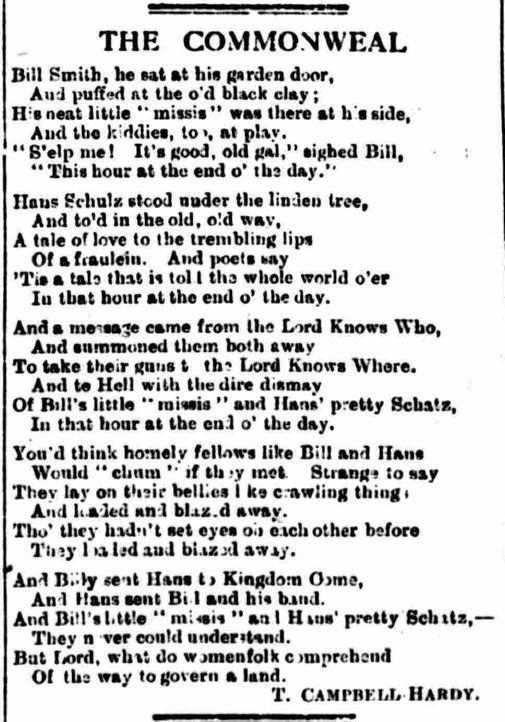
‘The Commonweal’ by T. Campbell Hardy

thhe commonweal

CaptureBill Smith, he sat at his garden door, and puffed at the old black clay [pipe]; his neat little missus was there at his side, and the kiddies, too, at play. ‘So help me! It’s good, old gal’, sighed Bill, ‘this hour at the end of the day.’

Hans Schulz stood under the linden tree, and told in the old, old way a tale of love to the trembling lips of a fraulein. And poets say ’tis a tale that is told the whole world o’er in that hour at the end of the day.

And a message came from the Lord Knows Who, and summoned them both away to take their guns the Lord Knows Where, and to hell with the dire dismay of Bill’s little missus and Hans’ pretty Schatz, in that hour at the end of the day.

You’d think homely fellows like Bill and Hans would chum if they met. Strange to say, they lay on their bellies like crawling things and blazed and blazed away. Though they hadn’t set eyes on each other before, they blazed and blazed away.

And Billy sent Hans to Kingdom Come, and Hans sent Bill and his band. And Bill’s little missus and Hans’ pretty schatz, they never could understand. But Lord, what do womenfolk comprehend of the way to govern a land.


Note: Yes, this is doggerel, but I find it none the less effective for that, and I hope you do too.

Armchair Strategists and Know-Alls

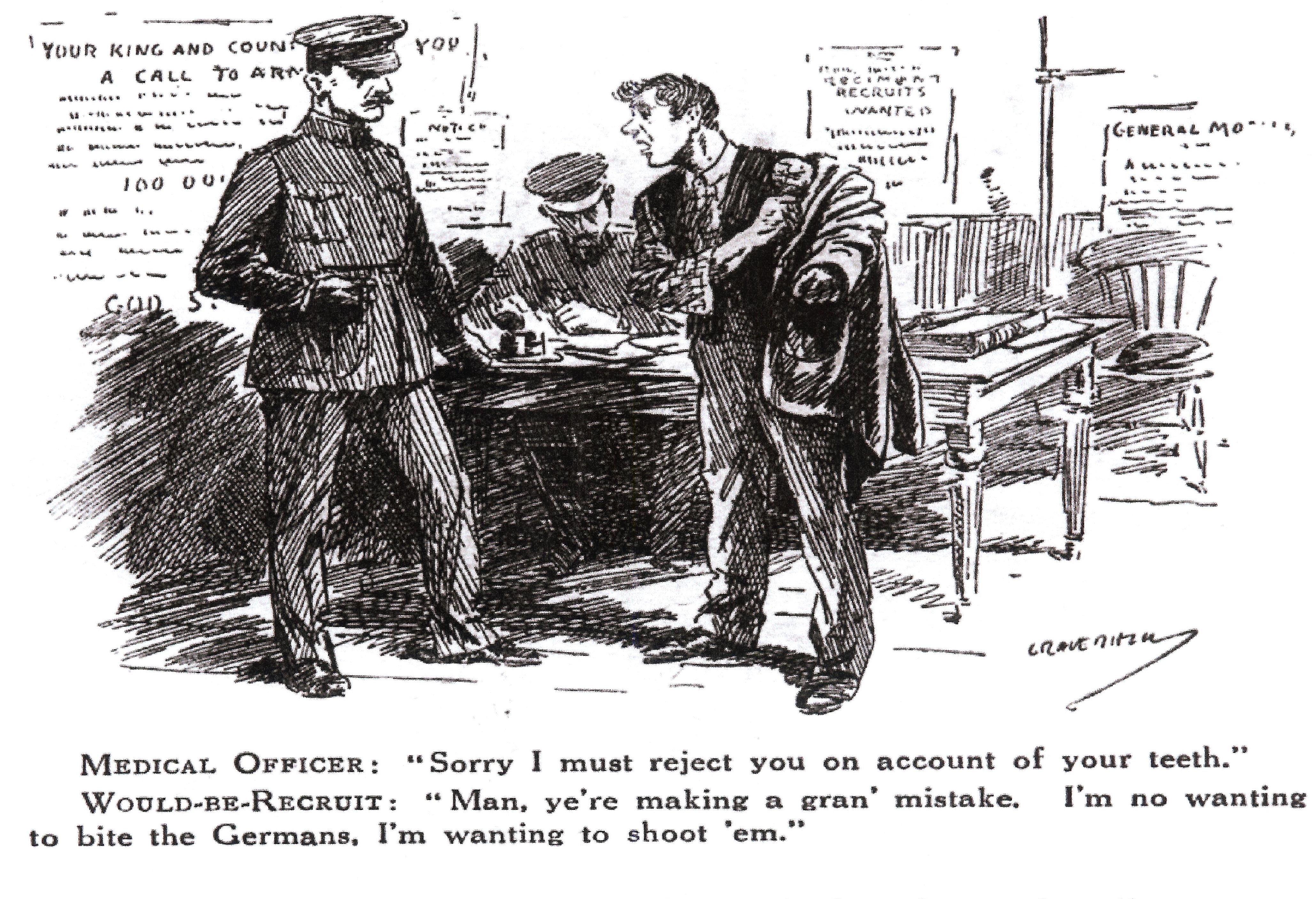
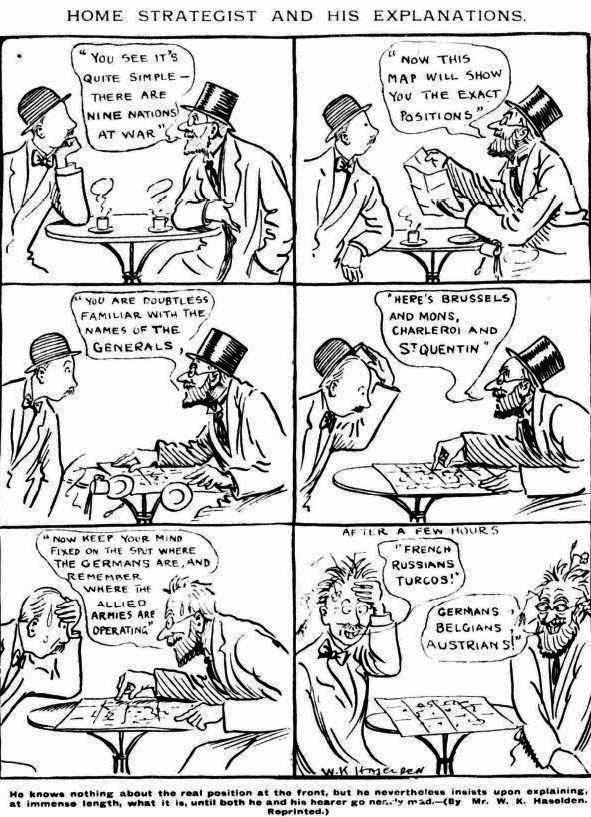
Daily mirror 3 September 19143 sep 1914Edward Judge looked forward to his morning constitutional along to the Reading Room opposite The George. It had become quite a home from home for him and his fellow village husbands who were no longer obliged to labour with their hands or their brains in order to earn their daily crust. The most uxorious of men needed to assert their independent interests outside the home (especially with all this suffragette nonsense) and it had become the agreeable custom to meet and exchange views in a place where no one would object if a fellow wanted to smoke a cigar or a pipe.

With this war on, it was becoming quite an important little gathering. The general view was that it was perfectly all right to leave the management of the village to the new 1parish council, so long as one or two of them sat on it and the decisions of the council were decided in advance by the Reading Room fraternity.

The problem about this, however, was brilliantly summed up by this morning’s cartoon in ‘The Daily Mirror’ (not that he would ever have such a rag in his own house – but the Reading Room had copies of most newspapers). Saloon strategists were the bane of all masculine gatherings, and simply had to be borne with gritted teeth.


1 The 1894 Local Government Act had introduced elected parish councils throughout the United Kingdom. In village terms, a constitutional change which is only 20 years old is (still) considered new.

William John Benham: The First Recruit to the Army Service Corps?

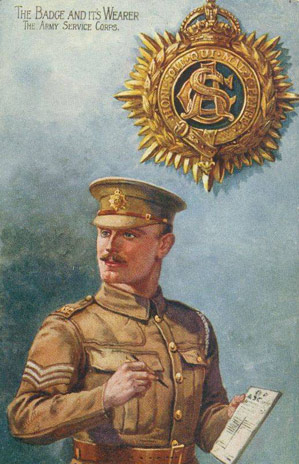
ASC_postcard_300

The Army Service Corps courtesy http://www.1914-1918.net/asc.htm

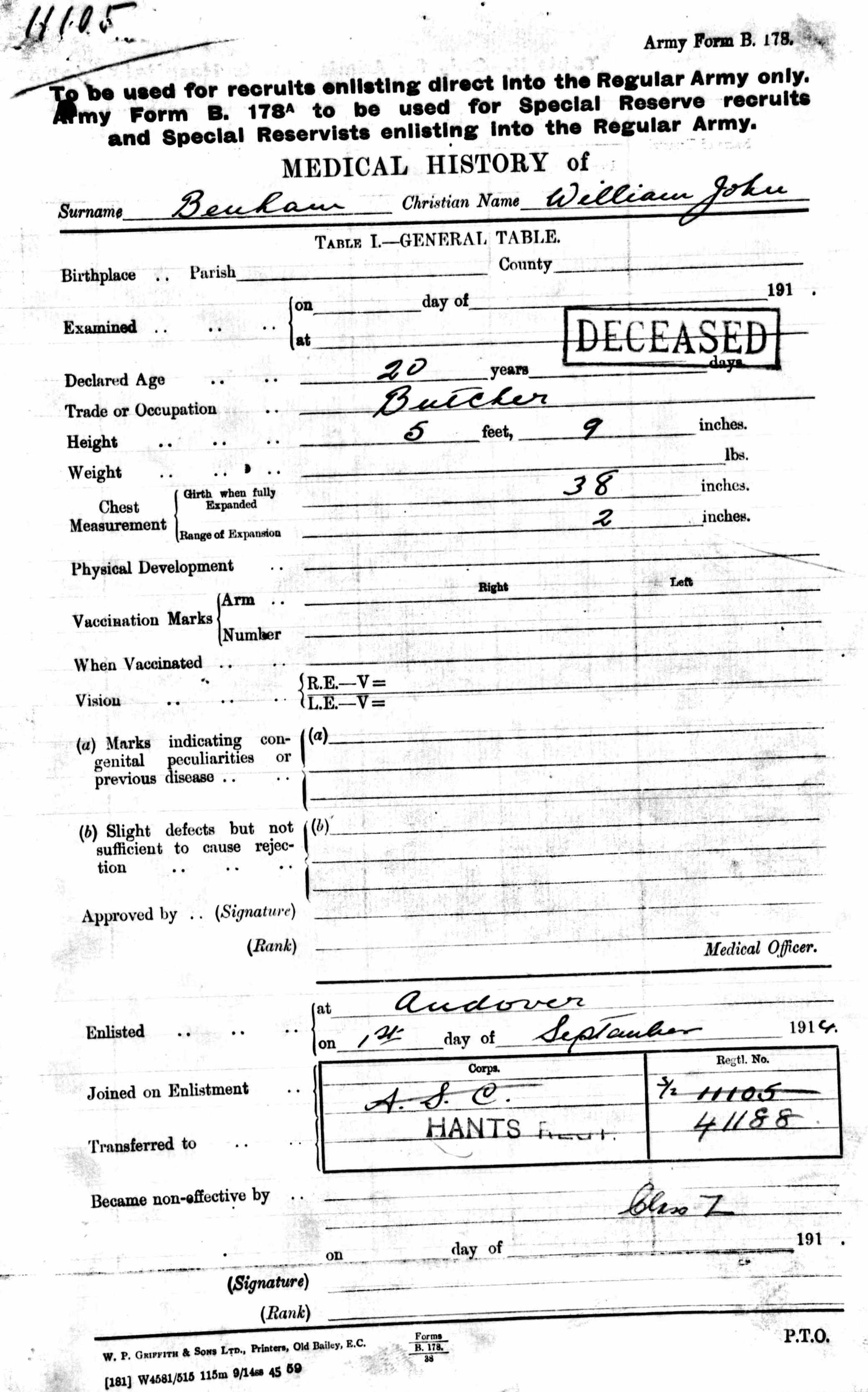
On 1st September 1914 William John Benham presented himself to the recruitment office in Andover and signed up to the Army Service Corps.

MIUK1914A_119410-00100(1)While working for Gilbert Culley, William John Benham had been living as one of the family 1. As they explained to the reporter from the Andover Advertiser, it was a blow to the Culleys to lose him so soon to the war effort:

St Mary Bourne

War Notes

War correspondents now-a-days have obscurity of diction enforced upon them with the avowed object of keeping the enemy in a fog, but this arbitrary restriction only succeeds in mystifying the British public. Some things, however, the enemy are bound to know and feel before very long, for some of our young men have the knack of making their presence felt in the fighting line in a remarkably short time. It may therefore not be regarded as disloyal to state that Messrs.Culley Brothers have lost several of their men—all total abstainers and lads that can be depended on in any emergency. Messrs.Culley Brothers recognise the voluntary system of the country; and have not therefore placed any pressure on their men to go; but when their men expressed the decision to go Messrs.Culley paid them their Michaelmas money in advance, and assured them that their places would be kept open for them. The names are Frank Cummins, William Benham, and Wedge, the two former having been three and seven years respectively in Messrs.Culley’s service. Mr.Ewart Culley is with the Territorials. Notwithstanding the loss of their men, Messrs.Culley were able to finish their harvest on Tuesday. The determination to keep the men’s places open for them entails a good deal of hard work and self-sacrifice upon Mrs.Culley, her son Mr.Gilbert Culley, and all at home. Mrs.Culley lost her husband six years ago, and is particularly hard hit by the outbreak of war.


Andover Advertiser,  Friday, 18 September 1914


1 See 1911 census

Frank Cummins and the Wedges will be the subject of separate posts.

The Dog Days Of August

1171px-Colima_-_Dog_Effigy_-_Walters_20092051_-_Three_Quarter_Left

Aztec effigy of a dog made available under Creative Commons Licence

It had been the strangest August any of them could remember.

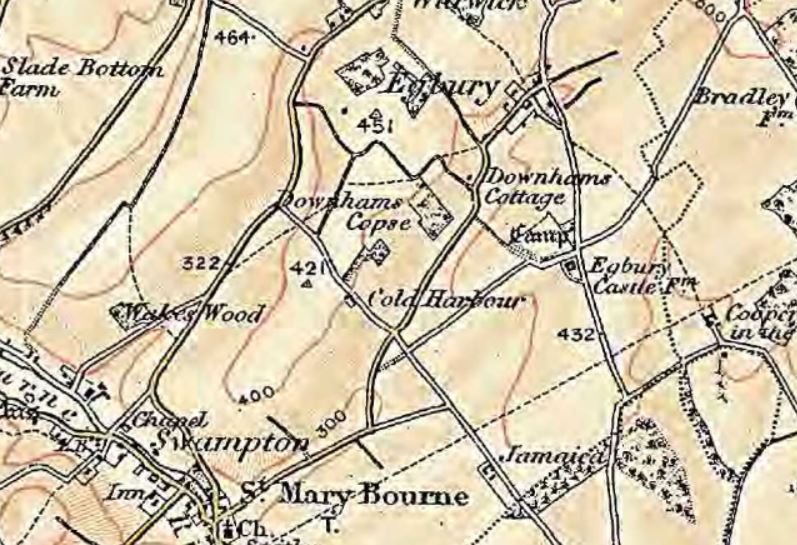
William Penny looked reflectively out of the window that morning at Egbury Castle Farm, which he had put his back into since marrying Harriet Mundy and coming here in the late 1860s. He was now seventy-five years old, and had passed most of the farming work on to his two surviving sons, Reginald and Ernest. But you could be sure he kept a pretty close eye on what they were up to, and there was little that escaped his gaze.

Egbury ‘Castle’ was so called after the prehistoric camp (Castrum) which had been discovered nearby, where Roman coins had been found. It pleased William to ponder that this land had been farmed, probably continuously, for thousands of years.

The month had begun unusually enough with the declaration of war, no one was quite sure why. Well, yes, someone had to stick up for the Belgians and the French weren’t much good at defending themselves against the Germans, so it was inevitable really. But since then, nothing. Well, almost nothing. It was always a quiet time of year when time seemed to stand still, the ‘Dog Days‘ from 16th July to 24th August. Some mammals hibernated, but personally he was all for aestivating.

The newspapers were still delivered, and he was well aware that the war was indeed up and running – the British Expeditionary Force had been defeated at Mons and had had to retreat. Not a glorious start. But so far the effect on the day to day life of the village was nil, it seemed to him.

Five of the village lads had set off to re-join their regiment but, until last week, they had been marching up to the top of a Winchester hill and down again to a Harrow plain, so far as he could make out. They had finally arrived at the front in time for the fighting at Le Cateau, so from now on it would begin to have real resonance for St Mary Bourne.

Mind you, they had got some City clerks in to help with the harvest, that was a significant result of the war – pasty-faced and puny to a man, it took about three of them to do what a Hampshire man could do in a trice, and they kept complaining they were tired and needed a rest. If Britain ended up having to rely on physical specimens like that, heaven help us all!

Egbury Castle Farm2William Penny did not know it, but there was to be a similar atmosphere twenty five years later, in 1939, when this period was described as ‘the phoney war‘.

Mobilising a whole country, not just the armed services, for war is rather like asking a tanker to do a 180° turn – it takes a while to put into effect.

Although, as we shall see, St Mary Bourne was indeed insulated from some of the effects of the war, it would come to seem very real as time went on.


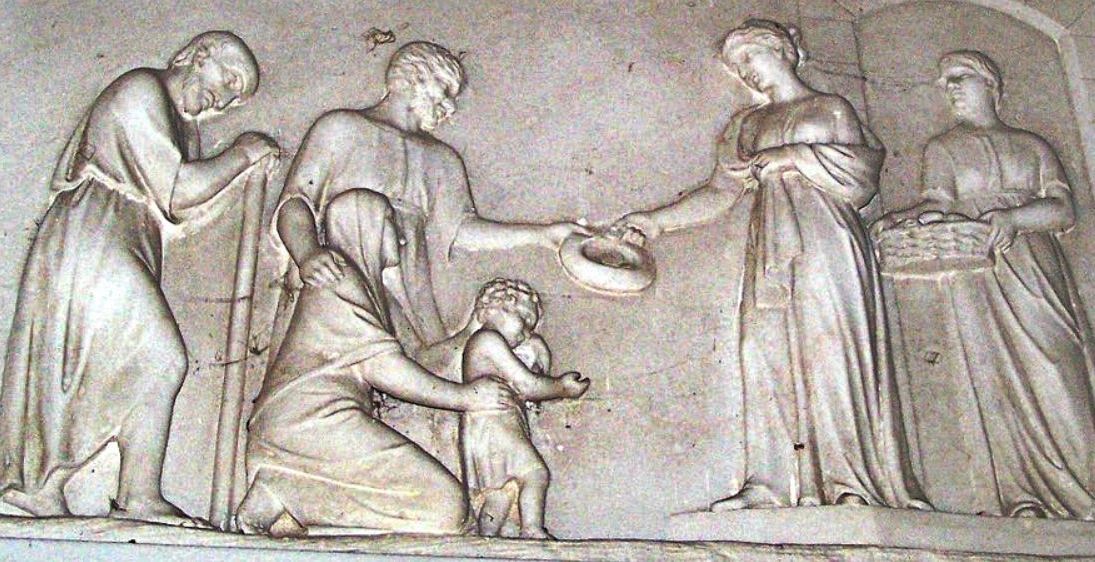
Charity Begins At Home?

Swinhope

Frieze at Swinhope, Lincolnshire


daily mirror 25 Aug 1914daily mirror 25 augustAll over the country, people were discussing how they could contribute to the war effort if they were women and not expected to fight at the front.

It is interesting that, as early as this, there was a tension between the natural temptation to economise by cutting down on the number of people the middle class employed, and the realisation (probably only among the few) that offering employment to the women who would be financially affected by having a husband, son or brother at the front was probably the single most useful example of ‘war work’. Also, it was easier for the recipient than having to be grateful to would-be Lady Bountifuls handing out the calves-foot jelly.